When applying for a personal loan or converting a credit card purchase into installments, Philippine banks often advertise attractive monthly add-on interest rates.
An offer of 0.75% or 1.5% monthly interest may sound affordable. But these figures do not necessarily reflect the true annual cost of borrowing.
Understanding the difference between add-on interest and effective interest rate (EIR) can help Filipinos compare financing offers, avoid expensive loans, and make better financial decisions in 2027.
Before accepting your next installment offer, here is what you need to know.
What Is Add-On Interest?
Add-on interest is a method of calculating interest based on the original loan or purchase amount over the entire repayment period.
Even as you make monthly payments and reduce your outstanding principal, the total add-on interest is determined using the original amount financed.
This method is commonly used in Philippine financing products such as credit card installments, personal loans, balance transfers, credit-to-cash arrangements, and appliance financing.
Add-on interest formula
Total interest = Principal × Monthly add-on rate × Number of months
Example: ₱100,000 loan at 1% monthly add-on interest
| Loan details | Amount |
|---|---|
| Loan amount | ₱100,000 |
| Monthly add-on rate | 1% |
| Repayment period | 12 months |
| Total interest | ₱12,000 |
| Total repayment | ₱112,000 |
| Monthly installment | ₱9,333.33 |
Although the advertised monthly interest rate is only 1%, the borrower pays ₱12,000 in interest over one year.
However, this does not mean that the effective annual interest rate is simply 12%.
What Is the Effective Interest Rate (EIR)?
The effective interest rate represents the actual annual cost of borrowing, considering the amount received, timing of repayments, interest, and applicable financing fees.
According to the Bangko Sentral ng Pilipinas loan calculator guide, comparing effective interest rates helps consumers determine which financing offer provides better value. Consumer Protection+1
Unlike the advertised add-on rate, the EIR reflects the fact that borrowers gradually repay their principal throughout the loan period.
Add-on interest vs. effective interest rate
| Feature | Add-on interest | Effective interest rate |
|---|---|---|
| Main purpose | Quoting and calculating installment costs | Measuring actual borrowing costs |
| Calculation basis | Original loan amount | Loan proceeds and repayment cash flows |
| Accounts for repayment timing | Not directly | Yes |
| Includes applicable financing fees | Not necessarily | Yes |
| Useful for comparing loans | Limited | Yes |
| Common presentation | Monthly percentage | Annual percentage |
How Much Is Your Real Interest Rate?
The difference becomes clearer when comparing monthly add-on rates with their equivalent effective annual interest rates.
The following examples assume a 12-month loan, equal monthly repayments, and no additional fees.
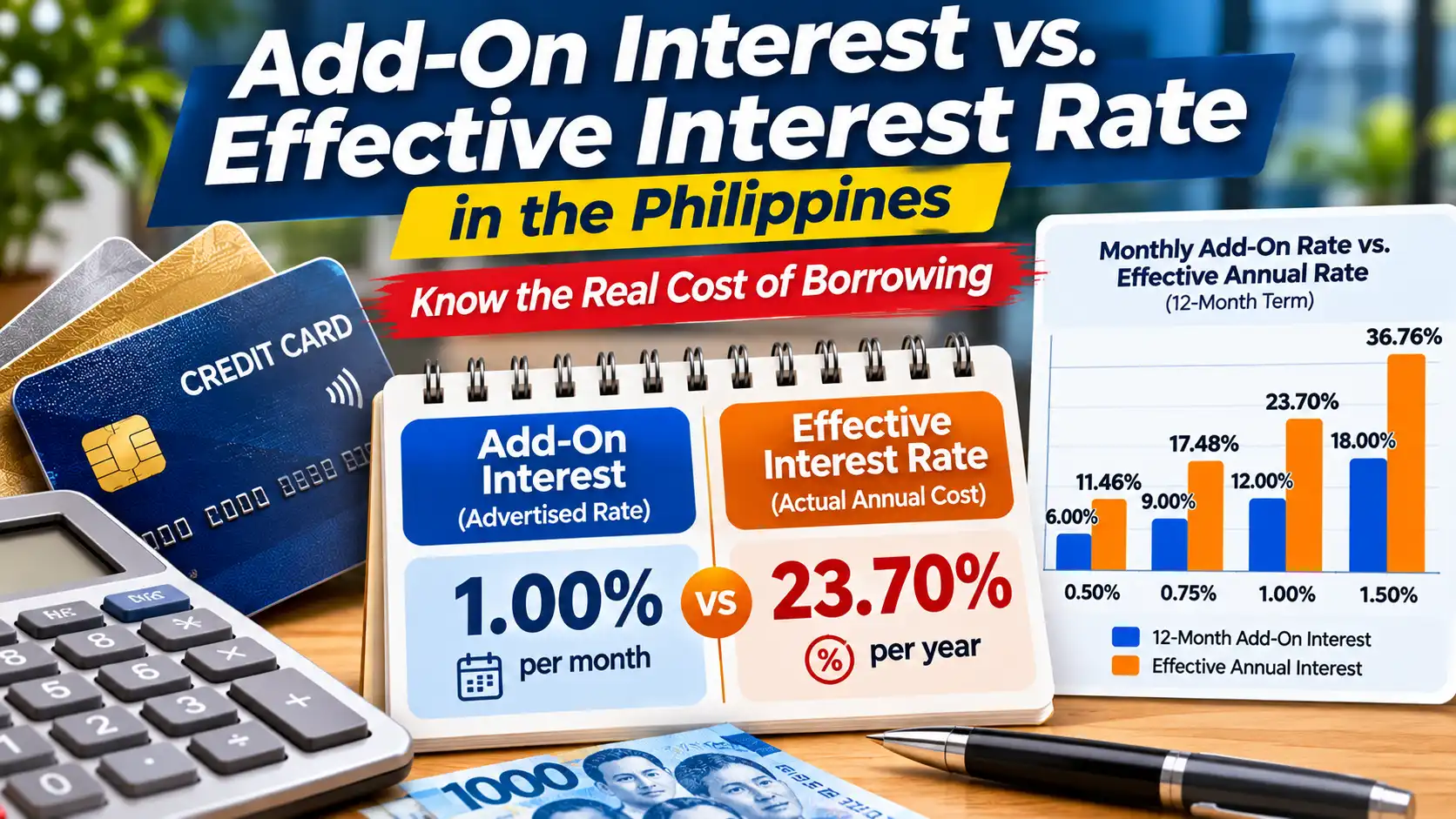
| Monthly add-on rate | Total add-on interest over 12 months | Effective annual rate |
|---|---|---|
| 0% | 0% | 0% |
| 0.50% | 6% | 11.46% |
| 0.75% | 9% | 17.48% |
| 1.00% | 12% | 23.70% |
| 1.50% | 18% | 36.76% |
Add-On Interest vs. Effective Annual Interest
Comparison of borrowing costs for a 12-month installment.
Calculations assume equal monthly payments beginning one month after borrowing. Effective annual rates are calculated using discounted repayment cash flows. Actual bank rates and fees may differ.
As the comparison shows, a financing offer advertised at 1.5% monthly add-on interest can have an effective annual interest rate of approximately 36.76%.
This does not mean the bank charges an additional 36.76% on top of your installment payments. The EIR expresses the equivalent annual borrowing cost based on the repayment cash flows.
How Processing Fees Increase Your Effective Interest Rate
Interest is not the only expense associated with borrowing. Processing fees can make a loan more expensive even when the advertised interest rate remains unchanged.
Consider a ₱100,000 personal loan at 1% monthly add-on interest, payable over 12 months.
| Loan details | Without fee | With ₱2,000 fee |
|---|---|---|
| Loan amount | ₱100,000 | ₱100,000 |
| Processing fee | ₱0 | ₱2,000 |
| Net loan proceeds | ₱100,000 | ₱98,000 |
| Total installment payments | ₱112,000 | ₱112,000 |
| Monthly payment | ₱9,333.33 | ₱9,333.33 |
| Total borrowing cost | ₱12,000 | ₱14,000 |
| Effective annual rate | 23.70% | 28.58% |
The ₱2,000 processing fee increases the effective annual interest rate even though the monthly installment remains the same.
This example assumes the processing fee is deducted from the loan proceeds.
Use our Credit Card Installment Calculator Philippines to estimate the impact of interest rates, fees, and repayment periods.
What Does the BSP Say About Effective Interest Rates?
The Bangko Sentral ng Pilipinas issued Circular No. 730, Series of 2011 to improve transparency in loan transactions under the Truth in Lending Act.
The BSP’s disclosure framework helps borrowers understand important financing information, including the loan amount, finance charges, net proceeds, repayment schedule, and effective interest rate. Bangko Sentral ng Pilipinas+1
Before accepting a financing offer, request the official loan disclosure statement from your bank or lender.
For information about credit card interest rate ceilings, read our guide on Philippine Credit Card Interest Rates 2027.
How to Compare Loan and Credit Card Installment Offers
Before accepting any financing arrangement, check the following:
- Effective annual interest rate
- Total amount payable
- Monthly installment amount
- Processing fees and other financing charges
- Repayment period
- Early settlement charges
When comparing similar financing arrangements, a lower effective interest rate generally indicates a lower annualized borrowing cost. However, you should also compare total repayment and whether the monthly payments fit your budget.
Frequently Asked Questions
Is add-on interest the same as effective interest?
No. Add-on interest is calculated using the original amount financed, while effective interest considers repayment timing and applicable borrowing costs.
What is the effective interest rate of a 1% monthly add-on loan?
For a 12-month loan with equal monthly payments and no additional fees, the effective annual interest rate is approximately 23.70%.
Is a lower add-on interest rate always better?
Not necessarily. Processing fees and different repayment periods can affect the actual cost of borrowing.
Can a zero-interest loan have an effective interest rate?
Yes. If the financing arrangement includes mandatory processing fees or other financing charges, the effective interest rate can be greater than zero.
Final Thoughts
Understanding add-on interest versus effective interest rates is essential for anyone borrowing money in the Philippines.
An advertised monthly rate may appear affordable, but it does not always provide a complete picture of your financial obligations.
Before signing a loan agreement or accepting a credit card installment offer, check the effective annual interest rate, total repayment, and additional fees.
Knowing the real cost of borrowing can save you thousands of pesos.
Official references:
- BSP Circular No. 730 – Loan Transaction Transparency
- BSP Frequently Asked Questions on Truth and Transparency
- BSP Official Loan Calculator
Disclaimer: All calculations are illustrative and do not represent specific bank offers.