
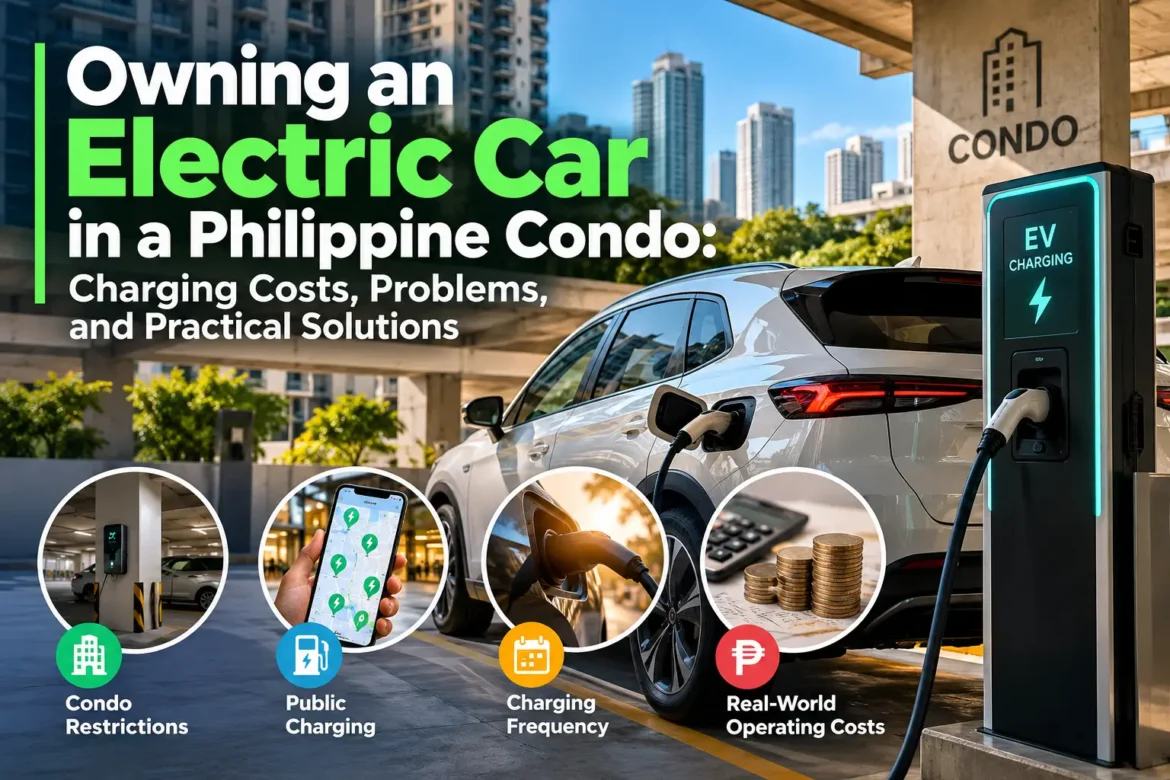
Electric vehicles promise lower running costs, quieter driving, and less dependence on gasoline. But for Filipinos living in condominiums, buying an electric car comes with one important question: Where will you charge it?
Unlike homeowners with private garages, condo residents often have limited control over parking facilities, electrical connections, and building regulations. Some condominiums have dedicated EV chargers. Others prohibit residents from connecting charging equipment to common-area outlets.
That creates a dilemma, particularly in Metro Manila, where many people live in high-rise buildings and rely on public parking facilities.
Can you realistically own a fully electric car without a home charger? How frequently would you need to charge? And would the savings over a gasoline vehicle justify the additional inconvenience?
The answer depends on how much you drive, where you live, and whether reliable charging facilities are available near your daily destinations.
The Biggest Challenge: Charging Without a Home Charger
For most EV owners, charging at home is one of the biggest advantages of electric car ownership.
You arrive home, connect the car, and leave the next morning with enough battery power for the day.
Condominium residents may not have that option.
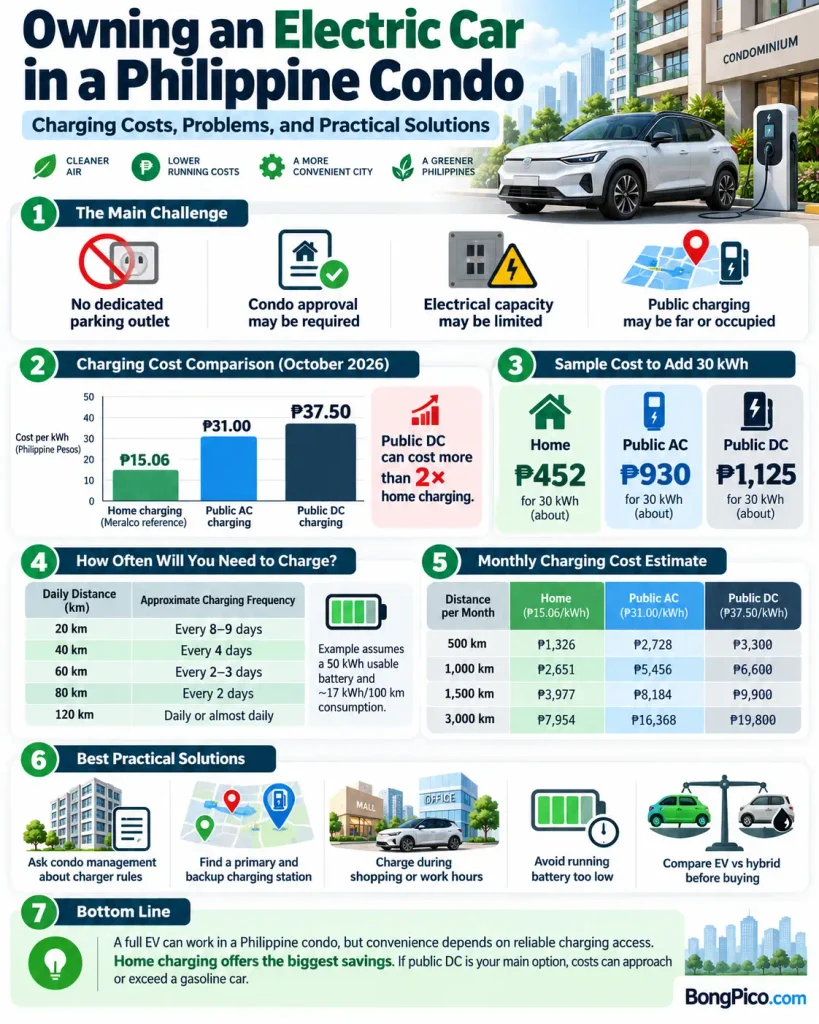
In a typical Metro Manila condominium, residents may face several restrictions:
- Parking spaces have no dedicated electrical outlets.
- Management requires approval for charger installations.
- Electrical infrastructure may not support additional high-powered equipment.
- Parking slots may be rented rather than privately owned.
- Charging from common-area electrical outlets may be prohibited.
- The nearest public charging station may be several kilometers away.
These challenges don’t necessarily make EV ownership impractical. They mean charging must become part of your driving routine.
Instead of thinking about where to fill up with gasoline, you need to consider where and when you can replenish electricity.
Can You Install an EV Charger in a Philippine Condo?
Yes, installing a private charging station in a condominium can be possible, but approval is not automatic.
The Philippines has legislation supporting electric vehicle infrastructure through Republic Act No. 11697, also known as the Electric Vehicle Industry Development Act (EVIDA).
However, this law does not mean every condominium resident has an unrestricted right to install a charging station in an existing parking space.
Property management, the condominium corporation, technical feasibility, electrical safety, and applicable permitting requirements still matter.
What condo management will typically examine
1. Parking ownership
Do you own your parking slot, rent it, or use an assigned common-area space?
A titled parking slot may make an installation request easier to justify. A rented or assigned slot may require additional approvals.
2. Electrical capacity
The building’s electrical system must have sufficient capacity to support the additional load.
A typical 7 kW AC charger can draw substantial power for several hours. Management may require an electrical load assessment before permitting installation.
3. Electricity billing
Who pays for the electricity?
Possible arrangements include connecting the charger to the resident’s electrical meter, installing a submeter, or using a management-operated billing system.
4. Fire and electrical safety
Charging equipment must be properly installed using suitable electrical protection, cables, and certified components.
Residents should not use improvised extension cords or ordinary parking outlets without explicit authorization and a professional electrical assessment.
5. Installation and maintenance
Management may also ask who is responsible for installation costs, equipment maintenance, insurance, and removal if the resident eventually moves out.
Practical advice
Before buying a fully electric vehicle, ask your condominium administrator:
- Are residents permitted to install private EV chargers?
- Does the building already have shared charging facilities?
- Can electricity be billed through a separate meter?
- Is there sufficient electrical capacity?
- What documents and approvals are required?
- Can a DOE-accredited charging service provider inspect the parking area?
Get the answers in writing.
The Department of Energy maintains information on accredited EV charging providers through its EV Industry Portal.
How Much Does It Cost to Charge an EV in the Philippines?
Electricity costs vary significantly between home charging and public charging.
As of October 2026, the difference is large enough to influence the overall economics of owning a fully electric vehicle.
Home charging versus public charging
Meralco’s October 2026 residential rate for a typical household is approximately ₱15.06 per kilowatt-hour (kWh).
Meanwhile, ACMobility announced increased public charging rates effective October 16, 2026, for selected regions.
| Charging method | Electricity rate |
|---|---|
| Home charging, Meralco October reference | ₱15.06/kWh |
| ACMobility public AC, Metro Manila from October 16 | ₱31.00/kWh |
| ACMobility public DC, Metro Manila from October 16 | ₱37.50/kWh |
These are reference figures, not universal rates. Public charging fees differ by operator, station, location, and pricing arrangement. Condominium submeter charges may also differ from residential utility rates.
Example: Charging a 50 kWh battery
Imagine an EV equipped with a 50 kWh usable battery capacity.
Charging from 20% to 80% adds approximately 30 kWh to the battery.
Allowing for charging losses, the electricity drawn from the charger may be somewhat higher.
For a simple comparison using 30 kWh billed at the advertised rates:
| Charging method | Approximate cost |
|---|---|
| Home at ₱15.06/kWh | ₱452 |
| Public AC at ₱31/kWh | ₱930 |
| Public DC at ₱37.50/kWh | ₱1,125 |
Actual bills depend on metered electricity, charging losses, parking charges, and any additional operator fees.
The important point is that public DC fast charging can cost more than twice as much per kWh as residential charging in this example.
That doesn’t automatically make a gasoline vehicle cheaper, but it reduces one of the financial advantages of EV ownership.
How Often Would a Condo Resident Need to Charge?
Charging frequency depends primarily on three things: battery capacity, electricity consumption, and distance traveled.
Manufacturers commonly advertise driving range using standardized testing procedures. Actual range can be lower because of air-conditioning, driving speed, terrain, traffic conditions, vehicle load, and other factors.
For illustration, consider an electric car with a 50 kWh usable battery and energy consumption of 17 kWh per 100 kilometers.
Its theoretical full-battery driving range would be approximately 294 kilometers.
But most drivers shouldn’t plan every trip around using the entire battery.
A more convenient charging routine is to operate between roughly 20% and 80%, subject to the manufacturer’s battery recommendations.
That gives approximately 176 kilometers of driving between those charging levels.
Estimated charging frequency
| Daily driving | Charging interval, approximately |
|---|---|
| 20 km | Every 8–9 days |
| 40 km | Every 4 days |
| 60 km | Every 2–3 days |
| 80 km | Every 2 days |
| 120 km | Daily or almost daily |
These estimates assume the same 50 kWh usable battery, 17 kWh/100 km consumption, and a 20%–80% charging window. They are not guaranteed ranges.
For someone who works from home and drives mainly on weekends, charging once a week may be enough.
For a commuter traveling across Metro Manila every day, twice-weekly or more frequent charging may be necessary.
For a vehicle used for ride-hailing services, the situation becomes more complicated.
What If You Use the EV for Grab or TNVS?
A fully electric vehicle used for Grab or another transportation network vehicle service can accumulate significantly higher mileage than a privately used car.
Consider a hypothetical driver traveling 180 kilometers daily while carrying passengers, repositioning, and returning home.
At 17 kWh per 100 kilometers, that requires approximately 30.6 kWh of battery energy each day.
With a 50 kWh usable battery, the driver may need to charge daily to maintain a comfortable reserve.
A charging stop also affects productivity.
Every minute spent driving to a charger, waiting for an available connector, or replenishing the battery is time that cannot be spent transporting paying passengers.
Practical implications for TNVS drivers
- Public DC fast charging may be necessary during operating hours.
- Charging locations should be close to common passenger routes.
- Drivers must account for charging queues and broken equipment.
- Frequent charging sessions create additional operational stops.
- An overnight charging arrangement can be especially valuable.
Fast charging can reduce downtime, but costs should be calculated against actual electricity rates and lost earning opportunities.
An EV operating commercially without reliable overnight charging requires much more careful planning than a privately driven EV.
Real-World EV Operating Costs: Monthly Examples
To make the comparison practical, consider a hypothetical EV consuming 16 kWh of battery energy per 100 kilometers.
Assume an additional 10% electricity allowance for charging losses. That means approximately 17.6 kWh is purchased for every 100 kilometers traveled.
Using October 2026 reference electricity prices:
| Monthly distance | Home charging | Public AC | Public DC |
|---|---|---|---|
| 500 km | ₱1,326 | ₱2,728 | ₱3,300 |
| 1,000 km | ₱2,651 | ₱5,456 | ₱6,600 |
| 1,500 km | ₱3,977 | ₱8,184 | ₱9,900 |
| 3,000 km | ₱7,954 | ₱16,368 | ₱19,800 |
Figures are illustrative, rounded, and based on charging energy costs only. Parking, subscriptions, idle fees, extra detours, financing, depreciation, insurance, maintenance, and charger installation are excluded.
For a condo resident driving 1,000 kilometers monthly, charging exclusively at public DC stations in this example costs approximately ₱6,600.
That’s almost ₱4,000 more per month than charging the same vehicle at home.
Over a year, the difference could reach approximately ₱47,000.
This highlights why EV ownership economics should be calculated according to your actual charging arrangement, not simply the manufacturer’s advertised energy efficiency.
Is an EV still cheaper than a gasoline car?
Potentially.
Imagine a gasoline vehicle averaging 12 kilometers per liter and gasoline priced at a hypothetical ₱75 per liter.
Traveling 1,000 kilometers would require approximately 83.3 liters, costing ₱6,250.
Under these assumptions:
- Home charging costs approximately ₱2,651.
- Public AC charging costs approximately ₱5,456.
- Public DC charging costs approximately ₱6,600.
- Gasoline costs approximately ₱6,250.
The EV offers substantial energy-cost savings with home charging. With exclusive public DC charging at the example rate, its energy cost is slightly higher than the gasoline example.
That comparison does not include maintenance differences, vehicle purchase price, or depreciation. Actual gasoline prices and vehicle efficiency will also change the result.
Where Can Condo Residents Charge in Metro Manila?
Public charging infrastructure has expanded into malls, commercial complexes, office developments, hotels, and selected residential properties.
Operators and platforms include ACMobility’s charging network and other providers listed through the DOE EV Industry Portal.
ACMobility also announced a May 2026 partnership with Robinsons Land to develop more than 200 charging points across a range of properties, including residential, office, and commercial developments. These are planned or developing installations, not a guarantee that every location is operational today.
How to find charging stations
Start with these resources:
EVRO — An EV charging application associated with ACMobility’s network, supporting charger discovery and charging sessions.
PlugShare — A community-driven EV charging map with station information and driver-submitted updates.
DOE EV Industry Portal — Government-supported information on the Philippine EV ecosystem and charging infrastructure.
Before visiting any charging station, verify its connector compatibility, current operating status, access rules, electricity price, and payment requirements.
Where public charging works best
Public charging is more convenient when it fits naturally into activities you already do.
For example, charging while shopping, dining, working, or attending an appointment is usually more efficient than making a separate trip solely to charge.
A condominium resident might charge during a weekly grocery trip or at a commercial development close to home.
However, public charging is less practical when facilities are frequently occupied, far from home, or unavailable outside business hours.
AC Charging vs DC Fast Charging: Which Is Better?
Public charging isn’t one-size-fits-all.
There are two common approaches.
AC charging
AC charging generally provides lower charging power and is better suited to longer parking sessions.
A 7 kW charger might take approximately five hours to deliver 30 kWh to the battery under favorable conditions, allowing for some charging losses and power variation.
That can work well if you’re parked at an office or shopping center for several hours.
DC fast charging
DC fast charging supplies electricity directly to the vehicle’s battery through its onboard battery-management system.
Depending on the vehicle and charging equipment, a 20%–80% charging session might take around 25–60 minutes, or longer.
But a charger labeled 120 kW does not mean every EV can accept 120 kW.
Actual charging speed depends on the battery’s state of charge, temperature, charge curve, and vehicle limits.
For condo residents, DC fast charging is often the more convenient option when time is limited. AC charging may be preferable when the vehicle can remain parked for several hours.
Does Regenerative Braking Help You Charge Less Often?
Yes, but there are limits.
Electric vehicles recover some kinetic energy during deceleration through regenerative braking.
Instead of converting all that energy into heat through conventional friction brakes, the motor can operate as a generator and return some energy to the battery.
This is particularly useful in stop-and-go Metro Manila traffic.
However, regenerative braking does not create electricity from nothing.
It recovers part of the vehicle’s existing kinetic energy. There are losses during energy conversion, and the recovered electricity cannot fully replace external charging.
An EV also does not normally recharge its battery simply because it is parked, idling, or cruising at a steady speed.
Drivers should treat regenerative braking as an efficiency benefit, not as a solution to limited charging infrastructure.
Seven Practical Solutions for Condo Residents Without Chargers
1. Identify a dependable primary charging station
Before buying an EV, find a charging location you can regularly access within a reasonable distance from home or work.
Check its opening hours, connector availability, pricing, and reliability.
2. Find at least one backup charger
Never rely entirely on one public charging station.
Equipment may be unavailable because of maintenance, software issues, electrical problems, or other vehicles occupying the space.
3. Schedule charging around existing activities
Plan sessions during shopping trips, work hours, or regular errands.
The goal is to minimize the extra time spent specifically on charging.
4. Avoid running the battery unnecessarily low
Maintain enough reserve to reach another charging station if your preferred charger is unavailable.
For routine use, many owners find a moderate battery range convenient, but charging limits should follow manufacturer recommendations.
5. Ask condo management about shared chargers
A building-wide charging installation may be more practical than allowing each resident to install individual equipment.
Shared chargers can include controlled access, electricity metering, and defined parking rules.
6. Compare your monthly charging budget before buying
Calculate your expected mileage and the electricity consumption of your preferred EV.
Then compare the cost of home, public AC, and public DC charging.
Include parking fees and the additional travel required to reach chargers.
7. Consider a hybrid if charging remains difficult
A hybrid electric vehicle uses regenerative braking and an onboard engine to reduce fuel consumption without requiring external charging.
A plug-in hybrid can operate partly on electricity and use gasoline for longer journeys, but the financial advantage of the plug-in system is reduced when it is rarely charged.
For some condominium residents, a conventional hybrid may provide a more convenient balance between fuel efficiency and everyday usability.
What About Portable Power Stations and Backup Batteries?
Portable power stations are not generally a practical primary charging solution for full-sized electric cars.
Consider a portable battery advertised with 2 kWh of storage.
Even if the vehicle could charge from it safely and the equipment were compatible, usable energy would be reduced by conversion losses.
For an EV consuming 16 kWh per 100 kilometers, 2 kWh represents just 12.5 kilometers of theoretical range before accounting for those losses.
That makes a small portable power station unsuitable for regularly charging an electric car.
Larger mobile charging equipment exists, but it is a different category of product with substantial cost, weight, and technical requirements.
Never assume a portable power station can safely charge an EV through an ordinary outlet. Compatibility, grounding, electrical protection, and manufacturer guidance matter.
What Should You Check Before Buying an EV for Condo Living?
Use this checklist before signing a vehicle financing agreement.
- Confirm whether your condominium permits EV charger installation.
- Identify your nearest dependable public charging station.
- Identify at least one backup charging location.
- Verify charging connectors and compatibility with your preferred vehicle.
- Calculate your actual daily and monthly driving distances.
- Estimate your monthly charging costs using public station rates.
- Check how long typical charging sessions will take.
- Include parking costs, charging detours, and waiting time.
- Check battery warranty terms and maintenance requirements.
- Compare an EV with conventional hybrid and plug-in hybrid alternatives.
The decision should be based on the entire ownership experience, not only the vehicle’s advertised range.
Frequently Asked Questions
Can I own an EV without a home charger?
Yes. You can rely on public charging stations if suitable facilities are available near your home, workplace, or regular destinations. The main trade-offs are higher charging costs and additional time spent planning charging sessions.
How much does public EV charging cost in Metro Manila?
Rates vary by operator. ACMobility announced ₱31/kWh for AC charging and ₱37.50/kWh for DC charging in the National Capital Region starting October 16, 2026. Always verify live prices before charging.
How often should I charge my EV?
That depends on battery capacity, driving distance, and energy consumption. For a 50 kWh usable battery consuming 17 kWh per 100 km, the energy between 80% and 20% can provide approximately 176 km of theoretical driving.
Can I charge my EV from a normal condo parking outlet?
Not without proper authorization and an electrical assessment. Even when a socket physically fits a charging device, the circuit may not be suitable for continuous charging loads.
Can condo management refuse my charger installation request?
A management office may restrict installations for legitimate reasons involving common property, electrical capacity, safety, and building rules. EVIDA supports EV charging infrastructure but does not provide unrestricted permission for individual residents to modify common areas.
Is DC fast charging bad for the battery?
Modern EVs regulate charging power to protect their batteries. Frequent fast charging can increase battery stress in some conditions, especially at high temperatures or high states of charge. The actual impact varies by battery chemistry and vehicle thermal management. Follow the manufacturer’s guidance.
Is a fully electric car cheaper to operate than a hybrid?
Not always. Home charging can provide a substantial advantage, while expensive public DC charging can reduce or eliminate the energy-cost savings against an efficient hybrid. Purchase price, depreciation, insurance, maintenance, and driving patterns also matter.
Final Verdict: Is a Fully Electric Car Practical for Philippine Condo Living?
Owning an electric car in a Philippine condominium is possible, even without a dedicated parking charger.
But convenience becomes just as important as vehicle range and electricity costs.
If you have reliable public charging nearby, drive relatively short distances, and can conveniently charge while shopping or working, a fully electric vehicle can be a practical choice.
If you travel long distances every day, operate a vehicle commercially, or have limited access to charging stations, the ownership experience may become more demanding.
Public fast charging also costs significantly more than residential electricity, which means the financial advantage of an EV is not guaranteed.
For condominium residents, the smartest first step isn’t choosing an EV model.
It’s confirming where you will charge, how often you’ll need to charge, and how much that routine will actually cost.
Only then can you determine whether a fully electric car, plug-in hybrid, or conventional hybrid makes the most sense for your lifestyle.
References and Further Reading
- Republic Act No. 11697 — Electric Vehicle Industry Development Act
- Department of Energy — EVIDA Implementing Rules and Regulations
- DOE — Accredited EV Charging Providers, June 2026
- DOE — EV Charging Fee Advisory, August 2026
- GMA News — Meralco Rates Increase in October 2026
- Top Gear Philippines — ACMobility Charging Rates Effective October 16, 2026
- ACMobility — Robinsons Land Charging Infrastructure Partnership
Editor’s note: Electricity prices and charging availability change over time. All sample cost comparisons are illustrative and should be recalculated using actual vehicle consumption and the rates at the charging stations you intend to use.