
The United States has taken another major step against suspected state-sponsored cyber espionage, seizing seven internet domains connected to hacking tools allegedly operated by a Chinese cybersecurity company.
On October 8, 2026, the US Department of Justice (DOJ) and Federal Bureau of Investigation (FBI) announced a court-authorized operation targeting two cyber intrusion platforms known as Microscan and FishHub.
According to US authorities, the tools were used by individuals associated with Integrity Technology Group to identify weaknesses in computer networks, launch phishing attacks, and gain unauthorized access to sensitive systems.
The activity has been linked to a hacking operation known in the cybersecurity industry as Flax Typhoon.
Targets reportedly included American energy infrastructure, European and Asian airports, Taiwanese universities, and organizations operating critical public services.
The operation is significant not only because of the infrastructure seized, but because it exposes how modern cyber espionage can combine legitimate-looking security tools, compromised consumer devices, and carefully targeted phishing campaigns.
What happened in the US cybersecurity operation?
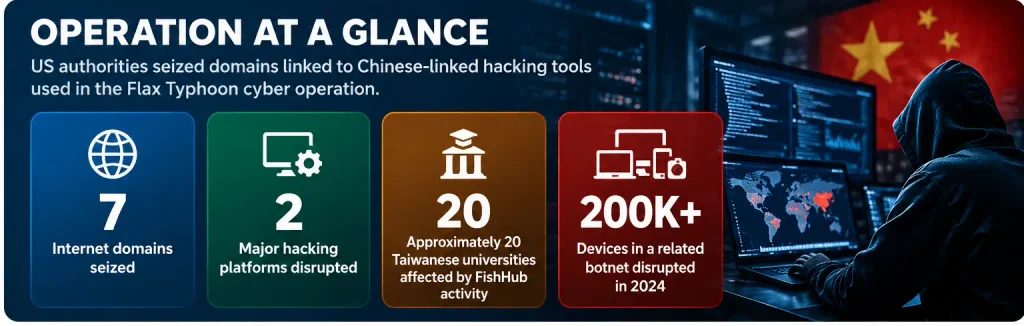
The Justice Department announced that federal authorities had obtained court authorization to seize seven domains associated with the alleged hacking infrastructure.
These domains helped operate or support tools used to scan networks, distribute malicious software, and maintain unauthorized access to compromised systems.
Officials said the seizures were intended to prevent continued access to infrastructure used by the suspected operators.
However, shutting down domains does not necessarily eliminate the individuals, malware, or other systems involved in a hacking campaign.
The operation represents a disruption of identified infrastructure, not proof that Flax Typhoon has permanently ceased operating.
Who is Flax Typhoon?
Flax Typhoon is the name cybersecurity researchers use for a China-linked threat group associated with long-running cyber espionage activity.
US investigators connect the group’s operations to Integrity Technology Group, a China-based company that provides cybersecurity services and has contracts with the Chinese government.
According to the FBI, the company allegedly developed or operated infrastructure that enabled threat actors to conduct large-scale reconnaissance and intrusion activities.
Cybersecurity researchers have also tracked related activity under names including RedJuliett and Ethereal Panda. Such threat-group labels do not always refer to precisely identical sets of operators.
Why would hackers target critical infrastructure?
Cyber espionage is not always about immediately shutting down systems or stealing money.
Attackers may attempt to obtain access to sensitive information, understand how critical networks operate, or establish a foothold that could support future operations.
Potential targets include power companies, telecommunications providers, government agencies, transportation systems, universities, and technology companies.
Access to these systems can provide valuable intelligence even when no visible disruption occurs.
The FBI’s allegations concern suspected state-linked activity. They should not be treated as a judicial finding that every person or organization named has been proven responsible.
Microscan: The tool used to search for vulnerabilities
One of the platforms targeted in the operation was Microscan.
According to investigators, Microscan was a Python-based web application containing more than 1,300 penetration-testing scripts.
These scripts could identify weaknesses in widely used software and network services, including WordPress, OpenSSL, Jenkins, Apache Struts, Oracle WebLogic, and other technologies.
Vulnerability scanning is not inherently malicious. Security professionals routinely scan systems they are authorized to test.
The concern arises when scanning is conducted without permission and used to support unauthorized access.
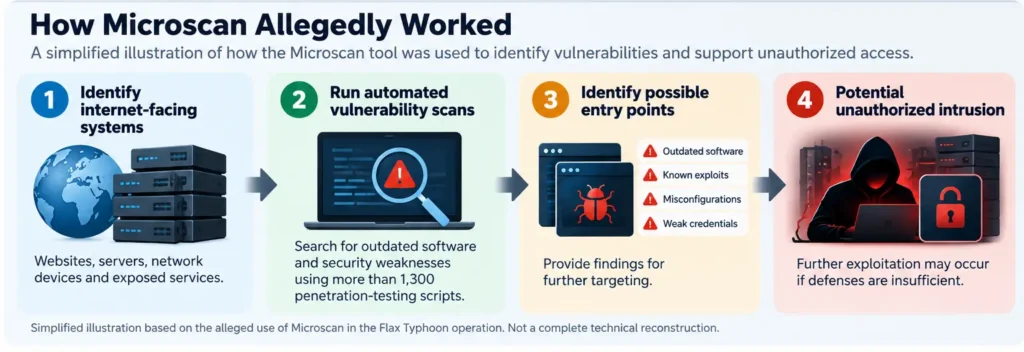
How Microscan allegedly worked
Investigators described a process involving reconnaissance, vulnerability identification, and subsequent exploitation.
- Identify internet-facing systemsWebsites, servers, network devices and exposed services
- Run automated vulnerability scansSearch for outdated software and security weaknesses
- Identify possible entry pointsProvide findings for further targeting
- Potential unauthorized intrusionFurther exploitation may occur if defenses are insufficient
US authorities identified targets of Microscan scanning that included a South Carolina power company, airports in Japan and Poland, Taiwanese energy companies, and a multinational nonprofit organization.
Being scanned does not necessarily mean that every targeted organization was successfully compromised.
FishHub: Phishing attacks and unauthorized access
The second major platform, FishHub, allegedly supported targeted phishing operations.
Unlike mass phishing campaigns that send generic fraudulent messages to thousands of people, spear phishing focuses on specific individuals or organizations.
Attackers may impersonate colleagues, trusted businesses, service providers, or familiar online platforms.
According to the Justice Department, FishHub was used in activity that could deliver additional malware after an initial compromise.
That malware could allow unauthorized remote access, search for sensitive files, and transmit information to attacker-controlled servers.
Approximately 20 Taiwanese universities were identified as confirmed victims of FishHub-related activity.
Investigators also described the use of remote administration software to maintain connections to compromised networks.
Why phishing remains dangerous
Even organizations with updated security software can be vulnerable when attackers successfully manipulate users into revealing credentials or executing malicious files.
An attacker who obtains a valid employee account may gain access without immediately triggering traditional malware detection.
This is why multifactor authentication, phishing-resistant login methods, employee awareness, and account activity monitoring are important.
The earlier Flax Typhoon botnet takedown
The October 2026 operation was not the first US action against infrastructure linked to Integrity Technology Group.
In September 2024, US authorities announced the disruption of a botnet involving more than 200,000 compromised consumer devices.
The botnet reportedly used a variant of Mirai malware to compromise internet-connected devices, including routers, cameras, and other equipment.
Once infected, these devices could be controlled remotely and used to support cyber operations.
The new domain seizures show that investigators continued pursuing infrastructure allegedly associated with the same company after the earlier disruption.
Why this matters to WordPress website owners
For website developers and businesses using WordPress, one detail stands out: Microscan reportedly included scripts capable of identifying weaknesses in WordPress and other commonly deployed web technologies.
That does not mean WordPress itself was uniquely targeted or that every WordPress website is vulnerable to this operation.
It means that exposed, outdated, or poorly secured web applications can become targets of automated reconnaissance.
Common weaknesses attackers look for
- Outdated WordPress core, themes, and plugins
- Vulnerable custom PHP code or API endpoints
- Weak or reused administrator passwords
- Unprotected staging environments
- Exposed management interfaces
- Misconfigured servers and access permissions
- Missing security updates on hosting infrastructure
Website owners should not assume that installing a security plugin is sufficient.
A practical defense requires maintenance, monitoring, controlled access, reliable backups, and a clear response plan.
A practical WordPress security checklist
Website security audit
[ ] Update WordPress core, plugins, themes, and server software
[ ] Enable multifactor authentication for administrator accounts
[ ] Remove unused plugins, themes, and inactive user accounts
[ ] Review access logs and investigate unusual login activity
[ ] Protect staging sites and administrative interfaces
[ ] Verify backups and test the restoration process
[ ] Use a web application firewall and appropriate rate limiting
[ ] Scan custom plugins and integrations for security issues
[ ] Monitor official vulnerability advisories
[ ] Review DNS, hosting, and administrator account security
0 of 10 completedUpdate WordPress core, plugins, themes, and server softwareEnable multifactor authentication for administrator accountsRemove unused plugins, themes, and inactive user accountsReview access logs and investigate unusual login activityProtect staging sites and administrative interfacesVerify backups and test the restoration processUse a web application firewall and appropriate rate limitingScan custom plugins and integrations for security issuesMonitor official vulnerability advisoriesReview DNS, hosting, and administrator account security
For developers managing multiple client websites, a centralized update and monitoring process is particularly valuable.
Security controls should be implemented consistently across production, staging, and development environments.
Could similar cyberattacks affect Philippine businesses?
Although the Justice Department’s announcement did not identify Philippine organizations among the named victims, the techniques described are relevant to businesses worldwide.
The Philippines has a growing digital economy supported by online banking, e-commerce, cloud services, business websites, and connected infrastructure.
Organizations that rely on internet-facing systems can face similar categories of threats regardless of location.
For Philippine businesses, important precautions include protecting employee credentials, securing websites and servers, keeping devices updated, and maintaining tested backups.
Organizations handling personal data should also consider their obligations under the Philippine Data Privacy Act of 2012, including appropriate safeguards and applicable breach notification requirements.
There is no basis in this announcement to claim that the seized infrastructure was used to compromise a specific Philippine bank, hospital, government agency, or company.
China’s response to the allegations
China rejected the US characterization of the alleged cyber activity.
In reporting by Reuters and the Associated Press, Chinese officials said the country opposes hacking and accused Washington of politicizing cybersecurity issues.
Integrity Technology Group did not respond to Reuters’ request for comment on the latest operation.
These responses are important because attribution of sophisticated cyber operations can involve technical evidence, intelligence assessments, and geopolitical disputes.
The domain seizures and court filings are documented US government actions. The alleged relationship between the operators and Chinese state-directed espionage remains an attribution made by US authorities, disputed by China.
Why governments are targeting hacking infrastructure
Traditionally, many cybercrime investigations focused on identifying suspects and pursuing criminal charges.
Modern enforcement efforts also attempt to disrupt the infrastructure that enables malicious operations.
This can include seizing domains, dismantling botnets, disabling command-and-control systems, and coordinating with international partners.
The advantage is that authorities may interrupt active operations even when the alleged operators remain outside their jurisdiction.
However, these actions have limitations.
Threat actors may rebuild infrastructure, register replacement domains, change malware, or move operations to different service providers.
The long-term effectiveness of the October 2026 seizures will depend partly on whether investigators and network defenders can prevent or detect renewed activity.
What happens next?
The FBI and its partners have published cybersecurity guidance to help defenders identify activity associated with Integrity Technology Group.
Security teams should review the relevant indicators of compromise, investigate suspicious activity where appropriate, and apply recommended mitigations.
The investigation remains significant because it highlights how cyber operations can span multiple countries, industries, and types of infrastructure.
Future developments may include additional enforcement actions, technical disclosures, or further evidence about the operation’s reach.
At present, it would be premature to claim that the Flax Typhoon threat has been permanently eliminated.
Final thoughts
The seizure of seven domains connected to Microscan and FishHub is a significant cybersecurity enforcement action.
It illustrates how sophisticated intrusion campaigns can rely on a combination of automated scanning, compromised internet-connected devices, phishing, and unauthorized remote access.
For website owners and developers, the lesson is practical: vulnerabilities that appear minor on an individual website can become part of a much larger attack surface when exploited at scale.
For governments and critical infrastructure operators, the case reinforces the importance of international cooperation and proactive cyber defense.
The disruption of hacking infrastructure is an important achievement, but maintaining secure systems remains an ongoing responsibility.
Frequently asked questions
What is Flax Typhoon?
Flax Typhoon is a cybersecurity industry name for a China-linked threat group associated with cyber espionage and network intrusion activity.
What did the FBI seize in October 2026?
US authorities announced the court-authorized seizure of seven internet domains associated with two tools, Microscan and FishHub.
What is Microscan?
Microscan is a vulnerability-scanning platform that US investigators allege was used to identify weaknesses in targeted networks.
What is FishHub?
FishHub is a platform allegedly used to support targeted phishing operations and the delivery of malware to compromised networks.
Were WordPress websites affected?
Microscan reportedly contained scripts capable of scanning WordPress-related weaknesses. However, the DOJ announcement does not establish that every WordPress site scanned was compromised.
Is Flax Typhoon still active?
The seized infrastructure was disrupted, but authorities have not established that the broader threat has permanently ended.
Were Philippine organizations targeted?
The official announcement did not specifically identify Philippine victims. That does not rule out possible activity elsewhere, but it would be incorrect to claim confirmed Philippine victims without evidence.
Sources and further reading
- US Department of Justice — Official seizure announcement, October 8, 2026.
- Reuters — US announces disruption of Integrity Tech hacking infrastructure, October 9, 2026.
- Associated Press — FBI seizes tools used by Chinese hackers, October 8, 2026.
- BleepingComputer — FBI disrupts hacking tools used against critical infrastructure, October 8, 2026.
- CyberScoop — DOJ and FBI seize Flax Typhoon-linked hacking tools, October 8, 2026.