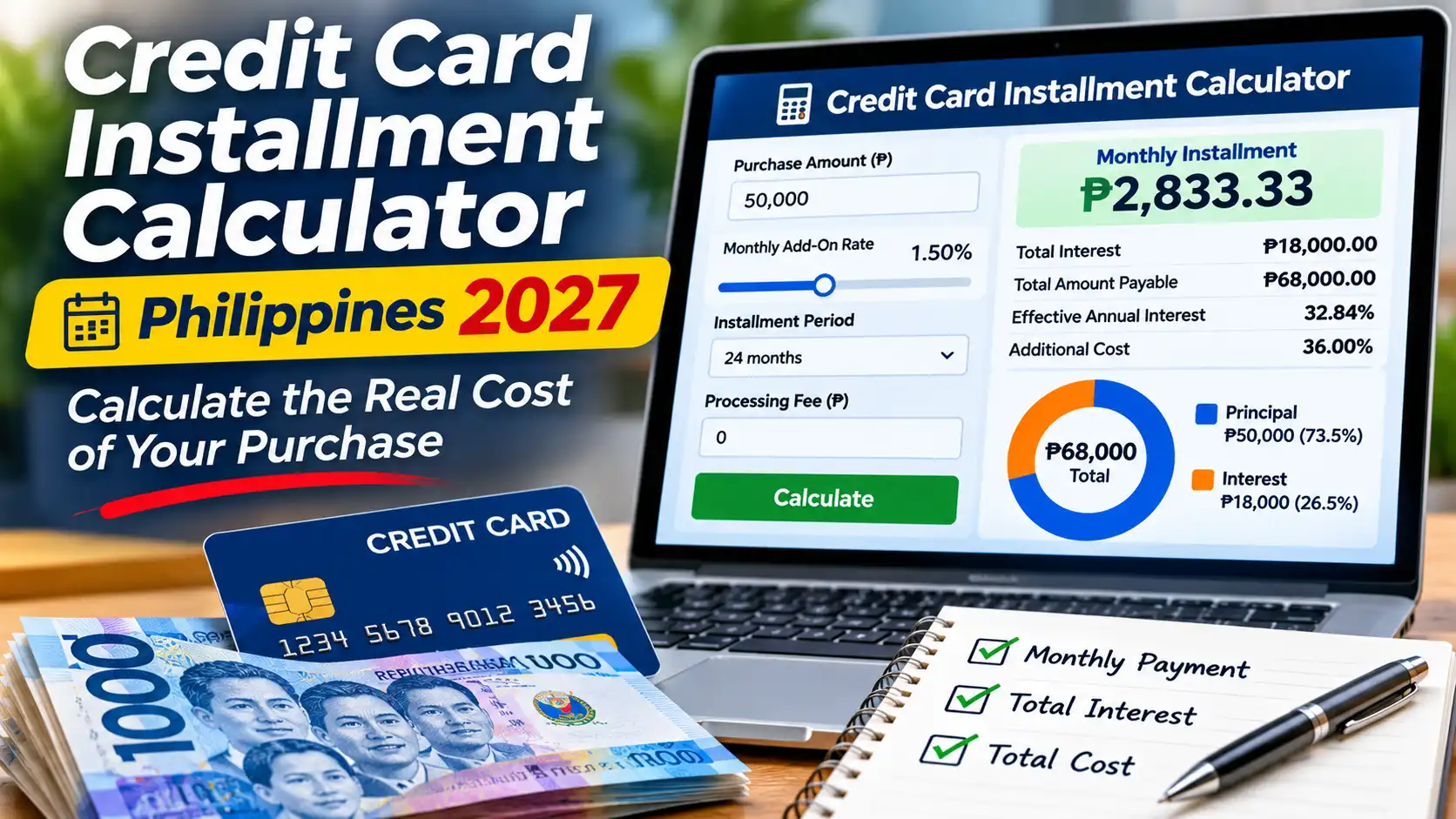
Buying a new smartphone, laptop, television, or home appliance through a credit card installment plan can make expensive purchases easier to manage. But affordable monthly payments do not necessarily mean you are getting a good deal.
Depending on your bank’s monthly add-on interest rate, repayment period, and processing fees, you could end up paying significantly more than the original purchase price.
Our credit card installment calculator for the Philippines helps you estimate your monthly payments, total interest, effective annual interest rate, and overall borrowing costs before committing to an installment plan.
Whether you use BDO, BPI, Metrobank, EastWest, UnionBank, RCBC, or another Philippine credit card, understanding how installment interest works can help you make better financial decisions.
Credit Card Installment Calculator Philippines
Enter your purchase amount, your bank’s quoted monthly add-on interest rate, your preferred repayment period, and any upfront processing fees.
The calculator will automatically estimate:
- Monthly installment payment
- Total installment interest
- Total amount payable, including fees
- Effective annual interest rate
- Additional cost as a percentage of the original purchase price
Use the calculator to compare different bank offers before making a purchase.
Credit Card Installment Calculator
Calculate your monthly payments, interest and total installment cost in Philippine pesos.
Estimates assume equal monthly installments, the first payment after one month, and fees paid upfront. Actual bank charges and available terms may differ. The effective annual rate uses annual compounding. No personal information is collected by this calculator.
What Is the Credit Card Installment Interest Rate in the Philippines for 2027?
Under BSP Circular No. 1242, Series of 2026, issued on November 10, 2026, the Bangko Sentral ng Pilipinas raised the monthly installment add-on interest rate ceiling from 1% to 1.5%.
The maximum regular credit card finance charge remains at 36% annually, equivalent to a 3% monthly nominal rate. Bangko Sentral ng Pilipinas+1
| Financing type | Interest rate |
|---|---|
| Zero-interest promotional installment | 0% |
| Discounted installment offer | Bank dependent |
| Previous monthly add-on ceiling | 1% |
| Revised monthly add-on ceiling | 1.5% |
| Regular monthly finance charge ceiling | 3% |
Remember that the revised 1.5% rate is a regulatory ceiling, not a mandatory rate. Banks can continue offering lower interest rates and zero-interest installment promotions.
Read our related guide: Philippine Credit Card Interest Rates 2027: What Every Cardholder Needs to Know.
How to Calculate Credit Card Installment Payments
Most credit card installment offers in the Philippines advertise a monthly add-on interest rate.
Unlike reducing-balance loans, add-on interest is calculated using the original purchase amount throughout the agreed repayment period.
Credit card installment formula
Total interest = Purchase amount × Monthly add-on rate × Number of months
Total repayment = Purchase amount + Total interest + Applicable fees
Monthly installment = (Purchase amount + Total interest) ÷ Number of months
The monthly installment formula assumes that any processing fees are paid separately upfront.
Sample credit card installment computation
Suppose you purchase a laptop worth ₱60,000 using a 24-month installment plan at a 1.5% monthly add-on interest rate.
| Particulars | Amount |
|---|---|
| Purchase price | ₱60,000 |
| Monthly add-on interest | 1.5% |
| Installment period | 24 months |
| Total interest | ₱21,600 |
| Monthly payment | ₱3,400 |
| Total repayment | ₱81,600 |
The installment arrangement adds ₱21,600 to the original purchase price, excluding additional fees.
Real Cost of a ₱60,000 Laptop
24-month installment at 1.5% monthly add-on interest.
Additional purchase cost: 36%
Additional bank fees are excluded.
Credit Card Installment Payment Comparison
The repayment period directly affects how much interest you will pay.
For a ₱50,000 purchase at a monthly add-on interest rate of 1.5%, the total borrowing cost increases as the installment period becomes longer.
| Term | Monthly payment | Total interest | Total repayment |
|---|---|---|---|
| 3 months | ₱17,416.67 | ₱2,250 | ₱52,250 |
| 6 months | ₱9,083.33 | ₱4,500 | ₱54,500 |
| 12 months | ₱4,916.67 | ₱9,000 | ₱59,000 |
| 18 months | ₱3,527.78 | ₱13,500 | ₱63,500 |
| 24 months | ₱2,833.33 | ₱18,000 | ₱68,000 |
| 36 months | ₱2,138.89 | ₱27,000 | ₱77,000 |
While the 36-month installment provides the lowest monthly payment in this example, it also produces the highest overall borrowing cost.
Compared with the 12-month plan, the 36-month arrangement costs an additional ₱18,000 in interest.
Why You Should Check the Effective Annual Interest Rate
A monthly add-on interest rate does not accurately represent the annual cost of borrowing.
For example, a 1.5% monthly add-on rate multiplied by 12 months equals 18% in add-on interest over one year. However, the effective annual interest rate is considerably higher because you gradually repay the principal throughout the loan period.
The effective interest rate also takes applicable financing fees into account, making it a more useful measure when comparing different loan offers. Bangko Sentral ng Pilipinas
Our credit card installment calculator estimates this rate based on your actual payment schedule and upfront fees.
Can You Use This Calculator for Any Philippine Credit Card?
Yes. The calculator works for fixed add-on installment offers from Philippine credit card issuers, including BDO, BPI, Metrobank, EastWest, UnionBank, Security Bank, RCBC, Chinabank, PNB, and HSBC.
Simply enter the actual interest rate and repayment period offered by your bank.
It can also help estimate the cost of balance transfers, purchase conversions, and credit-to-cash arrangements that use a fixed monthly add-on rate.
However, it is not designed to calculate revolving credit card balances, late payment penalties, or reducing-balance loans.
How to Save Money on Credit Card Installments
Before converting your next purchase into installments, compare several repayment options using the calculator.
- Look for genuine zero-interest installment promotions.
- Compare cash prices and installment prices.
- Ask your bank about discounted add-on rates.
- Select the shortest repayment period you can afford.
- Check processing fees and early settlement conditions.
- Avoid taking on multiple installment obligations at the same time.
Even a small reduction in your monthly add-on rate can translate into substantial savings over two or three years.
Frequently Asked Questions
How much is the monthly installment for a ₱50,000 credit card purchase?
At 1.5% monthly add-on interest over 12 months, the monthly payment is approximately ₱4,916.67. Total repayment is ₱59,000, excluding additional fees.
How do I calculate 0% credit card installments?
Divide the purchase amount by the number of monthly payments. A ₱60,000 purchase payable over 12 months at 0% interest costs ₱5,000 per month, assuming no additional fees.
Is a 1.5% monthly add-on interest rate expensive?
It can be, particularly for long-term installments. Over 24 months, this rate adds 36% to the original purchase amount.
Does the calculator include processing fees?
Yes. You can enter upfront processing fees to calculate the total borrowing cost and estimated effective annual interest rate.
Will my actual bank installment match the calculator?
The calculator provides estimates. Actual payments may vary because of rounding, billing dates, payment schedules, fees, and individual bank policies.
Final Thoughts
Using a credit card installment calculator before making a purchase can help you avoid unnecessary borrowing expenses.
Rather than focusing exclusively on affordable monthly payments, compare the total amount payable and the effective annual interest rate.
Credit card installments can be useful financial tools, but choosing the right interest rate and repayment period can make a substantial difference to your budget.
Official references:
Disclaimer: This calculator and article are provided for financial education. Actual interest rates, fees, and repayment arrangements depend on your credit card issuer.