
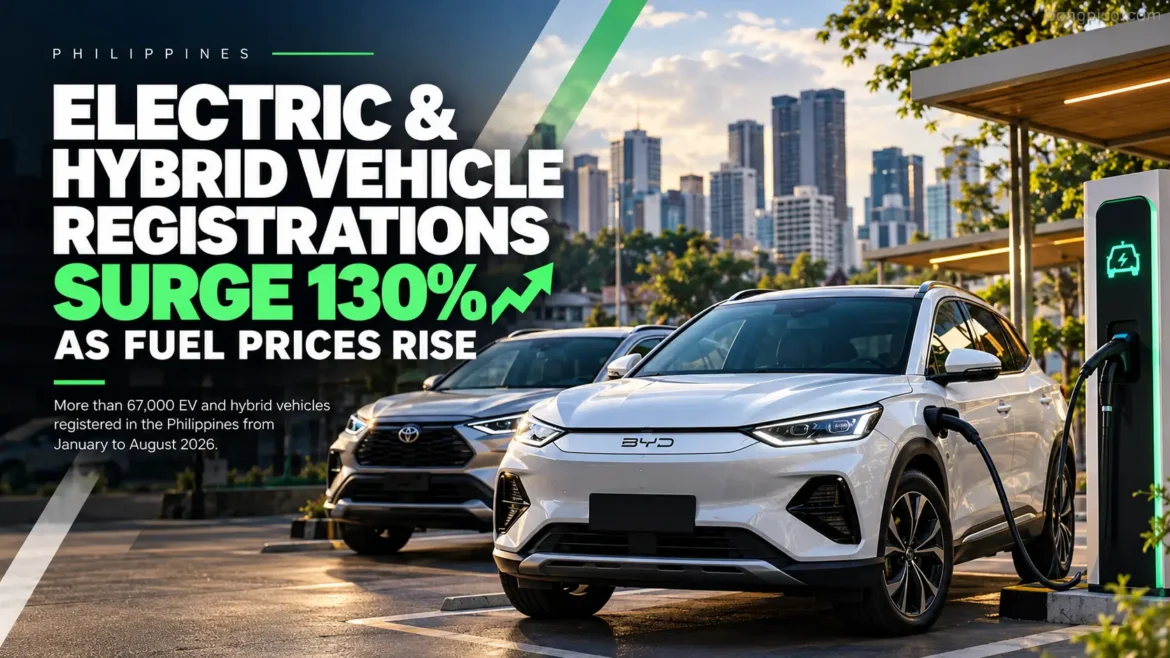
The Philippine automotive market is undergoing a significant transformation as rising fuel prices push more motorists toward electric and hybrid vehicles.
For decades, Filipino car buyers primarily considered gasoline and diesel vehicles. Today, fuel efficiency, battery technology, charging infrastructure, and long-term operating costs are becoming increasingly important in purchasing decisions.
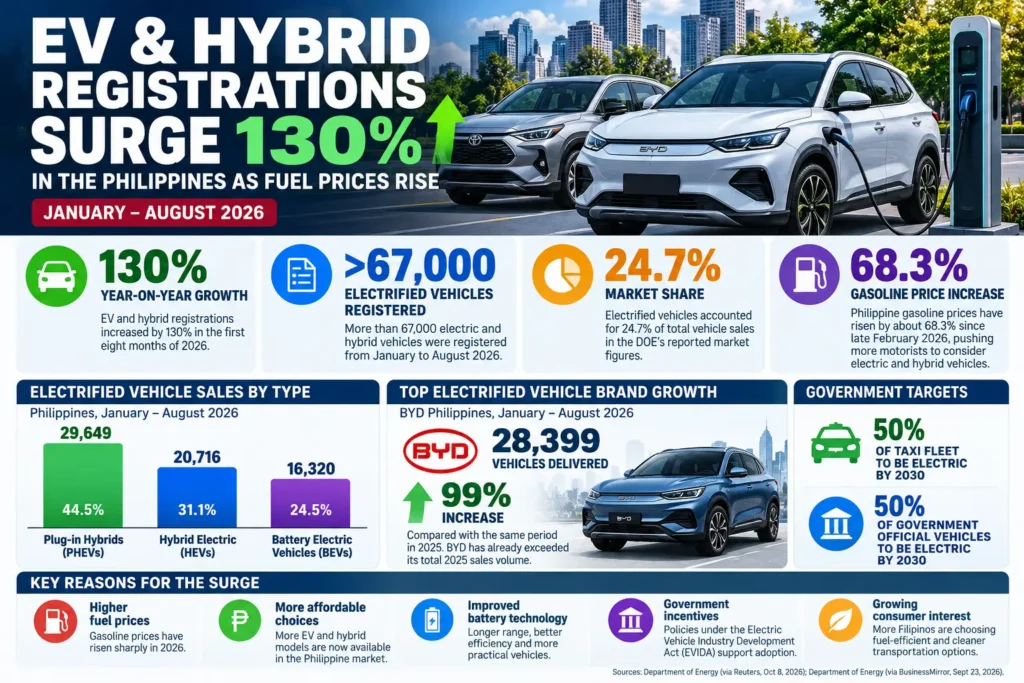
According to Reuters, citing the Department of Energy (DOE), registrations of electric and hybrid vehicles surged 130% year-on-year during the first eight months of 2026, exceeding 67,000 units.
The rapid increase suggests that electrified vehicles are moving beyond a niche market and becoming a serious alternative for Filipino motorists.
But behind the impressive numbers is a more complicated story involving international oil prices, changing consumer preferences, government incentives, new vehicle brands, and the country’s still-developing charging infrastructure.
Electric and Hybrid Vehicle Registrations Jump 130% in 2026
Patrick Aquino, director of the DOE’s Energy Utilization Management Bureau, told Reuters that registrations of electric vehicles, including hybrids, increased by 130% compared with the same eight-month period in 2025.
The increase occurred as gasoline prices climbed sharply following geopolitical disruptions in the Middle East.
The Reuters report, published October 8, cited data showing that Philippine gasoline prices had risen approximately 68.3% since late February 2026.
The Philippines imports nearly all of its petroleum requirements, leaving consumers particularly vulnerable to global oil-price movements.
When international crude oil and refined fuel prices rise, the effects are eventually reflected in local pump prices.
For motorists who drive daily, particularly commuters, delivery operators, and ride-hailing drivers, these increases can substantially affect monthly transportation expenses.
Consequently, fuel consumption has become a much bigger consideration when choosing a vehicle.
Breaking Down the Philippines’ Electric Vehicle Sales
Separate DOE figures reported by BusinessMirror in September provide a more detailed picture of the market.
During January–August 2026, the DOE reported approximately 66,685 electrified vehicles sold, representing 24.7% of an estimated 270,124 vehicles in its reported market figures.
The breakdown was:
| Vehicle category | Units sold | Share of electrified sales |
|---|---|---|
| Plug-in hybrid electric vehicles (PHEVs) | 29,649 | 44.5% |
| Hybrid electric vehicles (HEVs) | 20,716 | 31.1% |
| Battery electric vehicles (BEVs) | 16,320 | 24.5% |
| Total | 66,685 | 100% |
Source: DOE figures reported by BusinessMirror, September 23, 2026. Percentages are rounded.
The figures show that plug-in hybrids accounted for the largest share of reported electrified vehicle sales.
This is particularly interesting because plug-in hybrids combine electric driving capability with a gasoline engine.
They offer motorists the possibility of reducing gasoline consumption without depending entirely on public charging infrastructure.
A data clarification: The DOE’s September sales breakdown of 66,685 units and the October Reuters report of more than 67,000 registrations are separate reported measures. They should not be treated as identical totals. Different industry datasets also use different vehicle and market coverage.
Why Are Filipinos Buying More Electric and Hybrid Cars?
Several factors are contributing to the rapid growth.
1. Rising gasoline prices
The most immediate reason is the cost of fuel.
A motorist driving a conventional gasoline vehicle may spend several thousand pesos monthly on gasoline, depending on distance, traffic conditions, and vehicle efficiency.
For someone traveling long distances daily, even a relatively small increase in fuel prices can become a significant household expense.
Hybrids and electric vehicles promise lower gasoline consumption, or in the case of fully electric cars, no gasoline consumption at all.
That makes them increasingly attractive when pump prices are high.
2. More affordable vehicle choices
Electric and hybrid vehicles were once associated mainly with expensive imported models.
The Philippine market now offers more choices across different price ranges.
Manufacturers are introducing compact electric cars, hybrid sedans, hybrid SUVs, and plug-in hybrid crossovers.
Greater competition has made electrified vehicles accessible to a broader group of buyers, although many still cost more upfront than comparable gasoline models.
3. Improved battery technology
Modern batteries have become more capable, while vehicle manufacturers have improved energy management and charging systems.
These developments can provide longer electric driving ranges, better efficiency, and more practical everyday operation.
However, battery performance varies considerably by manufacturer, vehicle design, driving conditions, and battery age.
4. Government incentives
The Philippine government has introduced policies intended to encourage electric vehicle adoption.
These include the Electric Vehicle Industry Development Act and tariff incentives for qualifying electric vehicles.
Such measures can reduce some barriers to adoption and encourage manufacturers to expand their Philippine offerings.
5. Changing attitudes toward electrified vehicles
As more electric and hybrid cars appear on Philippine roads, buyers are becoming more familiar with the technology.
Consumers can now compare actual ownership experiences, maintenance requirements, fuel consumption, and charging arrangements.
This growing familiarity may make buyers more comfortable considering alternatives to conventional gasoline vehicles.
What’s the Difference Between EVs, HEVs, and PHEVs?
Not all electrified vehicles operate the same way.
Understanding the differences is essential before making a purchase.
Battery Electric Vehicles (BEVs)
A battery electric vehicle runs entirely on electricity.
It has no gasoline engine and must be charged using an external power source.
Advantages:
- No gasoline purchases.
- No tailpipe emissions.
- Potentially lower routine maintenance.
- Quiet operation and responsive acceleration.
Disadvantages:
- Requires reliable charging access.
- Charging takes longer than refueling.
- Public charging availability varies by location.
- Long-distance travel requires additional planning.
BEVs may be particularly attractive to motorists with reliable home charging and predictable daily travel.
Hybrid Electric Vehicles (HEVs)
A conventional hybrid combines a gasoline engine with an electric motor and battery.
Its battery is charged internally through regenerative braking and engine operation.
It does not require external charging.
Advantages:
- Better fuel efficiency than many comparable gasoline vehicles.
- No need for a home charger.
- Convenient for long-distance travel.
- Familiar gasoline-refueling experience.
Disadvantages:
- Still requires gasoline.
- Fuel savings vary by driving conditions.
- More complex powertrain than a conventional gasoline car.
- Battery and hybrid-system repairs can be expensive outside warranty coverage.
For motorists living in condominiums without charging facilities, conventional hybrids can be especially practical.
Plug-in Hybrid Electric Vehicles (PHEVs)
A plug-in hybrid combines a gasoline engine with a larger battery that can be charged externally.
Depending on the model, it can travel a useful distance using electricity before relying on its gasoline engine.
Advantages:
- Electric driving for some daily trips.
- Gasoline engine available for longer journeys.
- Potentially substantial fuel savings when charged regularly.
- Less dependence on public chargers during long trips.
Disadvantages:
- Requires regular charging to maximize electric-driving benefits.
- Usually heavier than a comparable conventional vehicle.
- Maintenance involves both electric and gasoline systems.
- Fuel savings may be disappointing if the owner rarely charges.
A plug-in hybrid can be an excellent compromise, but its benefits depend heavily on how it is used.
BYD Sales Nearly Double as Electrified Vehicles Gain Popularity
One of the biggest beneficiaries of the shift is Chinese automaker BYD.
According to Reuters, BYD Cars Philippines delivered 28,399 vehicles from January through August 2026, representing a 99% increase compared with the same period in 2025.
Bob Palanca, managing director of BYD Cars Philippines, said the company had already exceeded its entire 2025 sales volume before the end of August.
The figures demonstrate how quickly demand has grown for the brand’s electric and plug-in hybrid vehicles.
BYD has expanded its presence in the Philippines with vehicles designed for different buyer segments.
Its plug-in hybrid technology, marketed as DM-i, is particularly relevant to Filipino buyers who want to reduce fuel consumption while retaining a gasoline engine for longer journeys.
However, the rapid expansion of any automotive brand also raises important questions about after-sales service, parts availability, warranty support, and long-term resale value.
Consumers should evaluate these factors alongside purchase price and advertised fuel economy.
Toyota, Ford, Honda, and Other Brands Are Competing
BYD is not the only manufacturer participating in the electrification trend.
Toyota has established a strong presence in the conventional hybrid market, while Ford, Honda, Nissan, and other manufacturers offer various electrified models.
A separate CAMPI-TMA industry dataset reported by Carmudi identified Toyota as the leading hybrid brand within its participating manufacturers during January–August 2026.
The same dataset identified Jetour Auto as the leading plug-in hybrid brand and VinFast as the leading battery-electric brand within that reporting group.
These rankings should not be interpreted as the entire Philippine market because the dataset covers participating manufacturers and differs from the broader DOE figures.
Competition among established manufacturers and newer entrants is expected to influence pricing, technology, financing, and after-sales service.
For consumers, greater competition generally means more choices—but it also makes careful comparison increasingly important.
Are Electric Vehicles Really Cheaper Than Gasoline Cars?
Lower energy costs are one of the main attractions of electric vehicles.
However, the answer depends on the vehicle’s purchase price, financing, electricity costs, fuel efficiency, annual mileage, maintenance, insurance, and resale value.
Consider the following hypothetical example.
Sample monthly energy-cost comparison
Assume a motorist drives 1,500 kilometers monthly.
| Vehicle type | Assumed efficiency | Monthly energy cost |
|---|---|---|
| Gasoline vehicle | 12 km/L | ₱10,000 |
| Conventional hybrid | 20 km/L | ₱6,000 |
| Plug-in hybrid | 70% electric driving | ₱4,050 |
| Battery EV | 6 km/kWh | ₱3,000 |
Assumptions: Gasoline costs ₱80 per liter, electricity costs ₱12 per kWh, and the plug-in hybrid consumes 6 km/kWh in electric mode and 12 km/L in gasoline mode. Electricity figures exclude charging losses.
These are illustrative calculations, not actual October 2026 fuel-price quotations or guaranteed performance figures.
Under these assumptions, the conventional hybrid saves ₱4,000 monthly in fuel compared with the gasoline vehicle.
The plug-in hybrid saves approximately ₱5,950 monthly, while the battery EV saves around ₱7,000 in energy costs.
Actual savings may be smaller or larger.
Public fast-charging fees, charging losses, battery temperature, traffic, air-conditioning use, and driving behavior can all affect the result.
More importantly, lower running costs do not automatically mean lower total ownership costs.
A buyer must also account for financing interest, insurance, depreciation, repairs, registration, and eventual resale value.
Why Home Charging Is a Major Issue in the Philippines
One of the biggest challenges facing electric vehicle adoption is access to charging.
Motorists who own houses with private parking may find home charging relatively straightforward, subject to electrical safety and installation requirements.
Condominium residents face a different situation.
Some buildings do not have dedicated EV charging facilities, and installing a private charger may require approval from building management.
Additional issues include electrical capacity, parking arrangements, metering, and fire-safety requirements.
A driver who cannot charge at home may need to depend on public charging stations.
This can reduce convenience and, depending on charging fees, narrow the operating-cost advantage.
For such motorists, a conventional hybrid may provide fuel savings without introducing a charging requirement.
Plug-in hybrids remain an option, but buyers should calculate their likely savings if they cannot charge regularly.
Is the Philippine Charging Network Growing Fast Enough?
The DOE reported 1,876 registered EV charging stations nationwide as of August 2026, along with 949 recognized EV models.
The expansion is encouraging, but the total number alone does not establish whether charging is sufficient.
Several factors determine whether a charging network is practical:
- Geographic distribution of stations.
- Number of charging connectors at each location.
- Availability of fast charging.
- Compatibility with specific vehicles.
- Charging prices.
- Equipment reliability and maintenance.
- Accessibility during peak hours.
Metro Manila and other major urban centers may offer more options than provincial or remote areas.
For motorists who frequently travel long distances, route planning remains important.
A charging station listed online may also be occupied, temporarily unavailable, or incompatible with a particular vehicle.
Before purchasing a fully electric car, buyers should investigate the charging options along their actual travel routes.
Government Targets More Electric Taxis and Official Vehicles by 2030
The Philippine government is also encouraging electric vehicle adoption in public and government transportation.
According to the DOE official interviewed by Reuters, authorities are targeting electrification of 50% of the country’s taxi fleet and vehicles used by government officials by 2030.
This is a policy target, not a completed transition.
The DOE is also pushing to extend qualifying duty-free EV import incentives beyond their scheduled 2028 expiration.
Meanwhile, the government has discussed fiscal support of up to ₱60 billion through the Electric Vehicle Incentive Strategy to encourage domestic industry investment.
Such measures could help expand local vehicle assembly, component manufacturing, and related investments.
However, proposed incentives and investment programs should not be treated as fully disbursed funds or guaranteed economic outcomes.
What Is the Electric Vehicle Industry Development Act?
Republic Act No. 11697, also known as the Electric Vehicle Industry Development Act (EVIDA), provides a legal framework for expanding electric vehicle adoption in the Philippines.
The law covers areas including charging infrastructure, industry development, government planning, and support for electric mobility.
Its objectives include reducing dependence on imported petroleum, encouraging cleaner transportation, and developing the domestic EV industry.
But legislation alone cannot ensure widespread adoption.
Implementation requires coordination among national agencies, local governments, utilities, property developers, charging operators, and automotive manufacturers.
The availability of affordable vehicles and dependable charging will ultimately influence how quickly consumers switch.
Why Electric Motorcycles Are Not Growing as Quickly
Although electric cars and hybrids have gained momentum, electric motorcycles have faced slower adoption.
Motorcycles are among the most common forms of transportation in the Philippines.
They are widely used for commuting, deliveries, and small-business operations.
However, price remains a significant barrier for many buyers.
An electric motorcycle may offer lower operating costs, but its purchase price must still compete with affordable gasoline-powered models.
Battery range, charging time, repair support, and resale value also influence purchasing decisions.
The DOE expects more affordable electric motorcycles to help address this gap.
Reuters highlighted manufacturers such as VinFast introducing models priced below ₱100,000.
Even so, price competition alone may not be enough. The vehicles must also meet the practical requirements of everyday Filipino riders.
Why Jeepneys and Gasoline Motorcycles Still Matter
The rise of electric cars does not mean Philippine gasoline demand will immediately decline.
Traditional motorcycles, jeepneys, delivery vehicles, and other gasoline-powered transportation remain widely used.
Many operators face financial barriers to replacing their existing vehicles.
For public utility vehicles, electrification also involves questions about financing, route operations, maintenance facilities, passenger fares, and government support.
The country’s transport transition is therefore likely to occur at different speeds across different vehicle categories.
Private passenger cars may electrify faster than some forms of public and commercial transportation.
What Does the EV Boom Mean for Philippine Fuel Imports?
The Philippines is highly dependent on imported petroleum.
A larger fleet of electric and fuel-efficient vehicles could eventually reduce gasoline consumption relative to what it would otherwise have been.
This could help limit exposure to global oil-price volatility.
However, the effect will depend on the number of vehicles replaced, how much they are driven, and the continued growth of overall transportation demand.
Electricity generation also matters.
Charging electric vehicles increases electricity demand, and the environmental and energy-security benefits depend partly on the country’s power-generation mix.
An EV does not produce tailpipe emissions, but the electricity used to charge it may come from fossil fuels or renewable energy.
A meaningful assessment must therefore consider the wider energy system, not only the vehicle.
Will Electric and Hybrid Cars Become More Affordable in 2027?
Several developments could influence prices over the next year.
Growing competition may encourage manufacturers to introduce more affordable models.
Improvements in battery technology and manufacturing scale could also help reduce production costs over time.
On the other hand, foreign exchange movements, import duties, shipping expenses, and financing costs may push retail prices higher.
The peso’s value against the US dollar is especially relevant because many vehicles and components are imported.
Government incentives could also affect pricing.
For these reasons, it would be premature to guarantee that EVs and hybrids will become cheaper in 2027.
Buyers should compare actual dealer quotations rather than rely solely on expectations of future price reductions.
Should You Buy a Gasoline Car, Hybrid, Plug-in Hybrid, or EV?
The best choice depends on how and where the vehicle will be used.
| Buyer situation | Option worth considering |
|---|---|
| Daily city driving, no charging access | Conventional hybrid |
| Reliable home charging, predictable commute | Battery EV |
| Home charging plus frequent provincial trips | Plug-in hybrid |
| Low upfront budget and limited mileage | Efficient gasoline car |
| High annual mileage and dependable charging | Battery EV or PHEV |
| Condominium parking without EV facilities | Conventional hybrid or gasoline car |
These are starting points rather than universal recommendations.
A buyer driving only a few kilometers daily may take many years to recover the higher purchase price of an electrified vehicle through fuel savings.
Conversely, someone driving long distances every day may benefit substantially from improved efficiency.
Financing can also change the calculation.
A vehicle that saves ₱4,000 monthly in fuel but requires ₱8,000 more in monthly loan payments may not improve immediate household cash flow.
The most sensible approach is to calculate total ownership costs over the intended period of use.
What Buyers Should Check Before Purchasing an EV or Hybrid
Before making a decision, buyers should examine several practical questions.
Battery warranty: What is covered, how long does coverage last, and what exclusions apply?
Service network: Are trained technicians and authorized repair facilities available nearby?
Parts availability: How long might major repairs take?
Charging access: Can the vehicle be charged safely and conveniently at home or nearby?
Real-world efficiency: Does the vehicle achieve reasonable consumption in traffic and with air-conditioning?
Insurance: Are premiums, battery coverage, and repair conditions acceptable?
Resale value: Is there an established secondhand market for the model?
Financing: Does the vehicle remain affordable after including interest, insurance, and recurring ownership expenses?
These considerations can matter more than a manufacturer’s advertised driving range or fuel-economy figure.
Frequently Asked Questions
How much did EV and hybrid registrations increase in the Philippines in 2026?
According to the DOE official cited by Reuters, registrations increased by approximately 130% year-on-year during January–August 2026, exceeding 67,000 units.
Are hybrids included in the EV registration figures?
Yes. The reported electrified-vehicle figures include conventional hybrids, plug-in hybrids, and battery electric vehicles. These categories should not be confused with fully electric vehicles alone.
Which electrified vehicle category sold the most?
In the DOE’s January–August sales breakdown reported in September, plug-in hybrids led with 29,649 units, followed by conventional hybrids with 20,716 and battery electric vehicles with 16,320.
Do hybrid cars need charging?
Conventional hybrids do not require external charging. Plug-in hybrids can be charged externally, while fully electric vehicles depend on external electricity.
Are electric vehicles cheaper to maintain?
They can have lower routine maintenance requirements because fully electric vehicles have fewer conventional engine-related components. However, repairs, insurance, tires, and battery-related costs must still be considered.
Are EVs suitable for Philippine provincial travel?
They can be, but suitability depends on driving range, route conditions, charger availability, and charging time. A conventional hybrid or plug-in hybrid may offer greater flexibility where charging infrastructure is limited.
Is buying an EV a good financial decision?
It depends on total ownership cost, not just energy savings. Purchase price, financing, charging arrangements, maintenance, insurance, and resale value should all be included.
Will gasoline vehicles disappear in the Philippines?
There is no basis for predicting their near-term disappearance. Gasoline and diesel vehicles remain widely used, and fleet replacement takes time.
The Bottom Line: Philippine Motoring Is Changing
The 130% increase in electric and hybrid vehicle registrations is one of the clearest signs that Philippine motorists are reconsidering how they power their vehicles.
High gasoline prices have accelerated interest, but the transition is also being supported by expanding vehicle choices, government incentives, and growing consumer familiarity with electrified technology.
The shift is not without challenges.
Charging infrastructure remains uneven, purchase prices can still be high, and the economics of ownership differ significantly among households.
Conventional hybrids may appeal to motorists who want lower fuel consumption without charging. Plug-in hybrids offer a compromise for those who can charge regularly, while fully electric vehicles can provide substantial operating savings for drivers with reliable charging access.
For the Philippine automotive industry, the direction is becoming clearer: electrification is no longer a distant possibility.
The question is no longer simply whether electric and hybrid vehicles will become more popular, but how quickly the country can make them practical and affordable for ordinary Filipino motorists.
The Daily Caffeine will continue monitoring vehicle registration data, government incentives, fuel prices, charging infrastructure, and developments affecting Filipino car buyers.
Sources and references
- Reuters, October 8, 2026 — High gasoline prices drive EV sales surge in the Philippines
- BusinessMirror, September 23, 2026 — More electric cars on Philippine roads as of August, says DOE
- Philippine Statistics Authority — Number of Registered Electric Vehicles Increased Almost Fivefold in 2024
- Carmudi Philippines — Philippine Auto Industry Year-to-Date Sales Exceed 300,000 Vehicles in August 2026
- Republic Act No. 11697 — Electric Vehicle Industry Development Act (EVIDA).