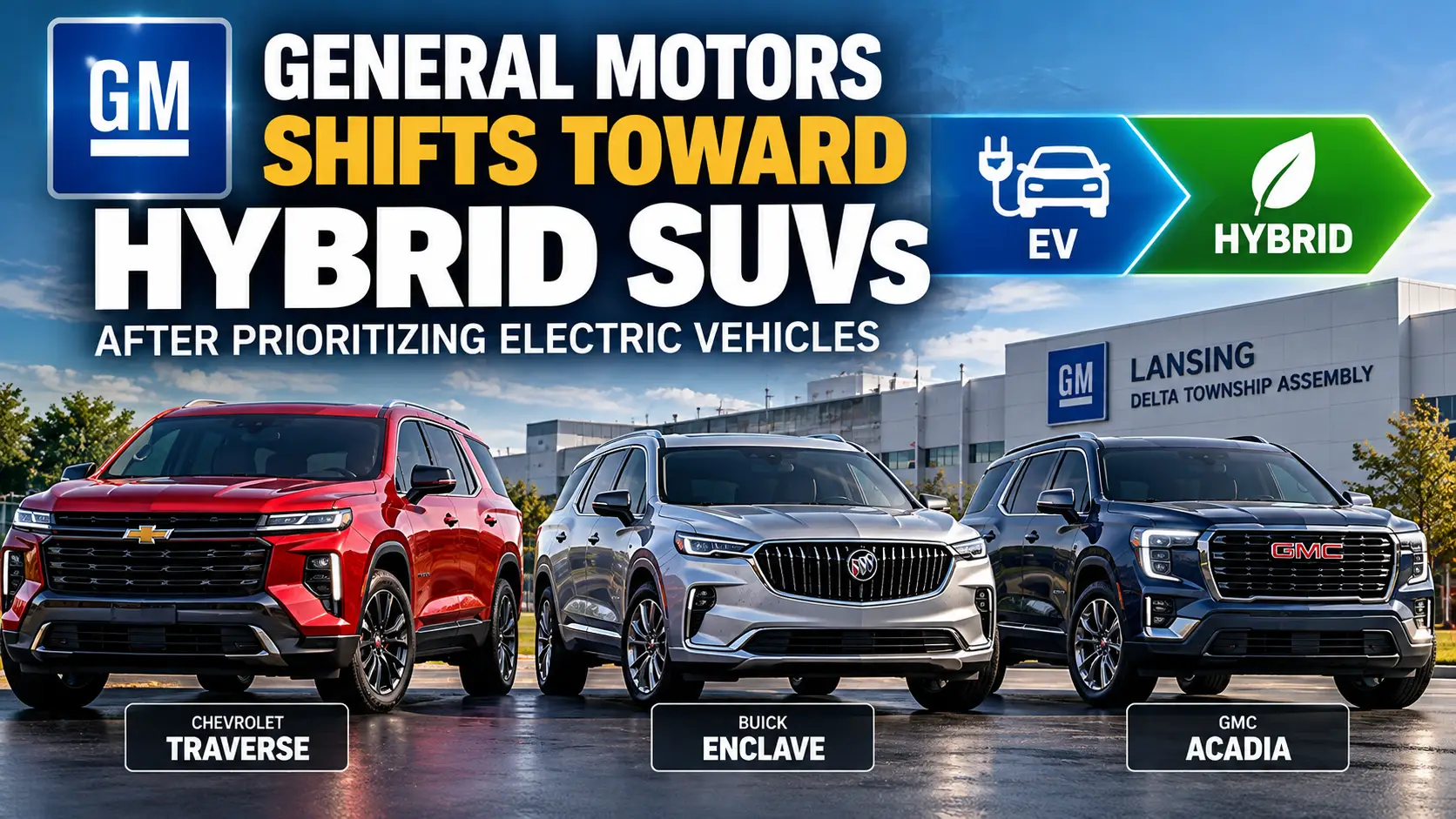
General Motors is expanding its strategy beyond fully electric vehicles.
On October 27, 2026, GM confirmed plans to prepare its Lansing Delta Township Assembly plant in Michigan for future hybrid-electric vehicle production. Reuters reported that the automaker intends to develop hybrid versions of the Chevrolet Traverse, Buick Enclave and GMC Acadia—three popular, three-row SUVs currently built at the plant.
There is an important distinction: GM has confirmed the factory’s hybrid-production plans, but has not officially confirmed the model names, powertrain specifications, prices or launch dates. Those model details come from Reuters’ reporting based on people familiar with the plans.
What General Motors Actually Announced
In its October 27 announcement, GM said it would prepare Lansing Delta Township Assembly for future hybrid-electric vehicle production. The factory currently manufactures the Chevrolet Traverse, GMC Acadia and Buick Enclave. GM said details about specific models and timing would follow closer to launch.
The announcement forms part of more than $2 billion in planned investments across the Lansing region over the coming years, including a previously announced $1.25 billion allocation for Lansing Grand River Assembly. That $2 billion figure is a regional investment total, not a confirmed budget solely for the new hybrid SUV program.
GM also said it and the U.S. Department of Energy are restructuring an existing Domestic Manufacturing Conversion Grant to support future hybrid production at Lansing Delta Township. The factory produced more than 291,000 vehicles in 2025, its highest annual output, according to GM.
Which GM SUVs Could Receive Hybrid Versions?
According to Reuters’ October 27 report, the following vehicles are being considered for hybrid variants:
| Vehicle | Current positioning | Hybrid status as of October 28, 2026 |
|---|---|---|
| Chevrolet Traverse | Three-row family SUV | Reported by Reuters; not individually confirmed by GM |
| GMC Acadia | Three-row SUV with an upscale, utility-oriented positioning | Reported by Reuters; not individually confirmed by GM |
| Buick Enclave | Premium three-row family crossover | Reported by Reuters; not individually confirmed by GM |
All three vehicles are produced at the same Michigan plant, which makes the site a logical starting point for a hybrid manufacturing expansion. However, GM has not disclosed whether the vehicles will use conventional hybrid, plug-in hybrid or other electrified powertrain configurations. Buyers should not assume specifications or availability before an official product announcement.
Why Is GM Expanding Into Hybrids Now?
1. Demand for fuel-efficient vehicles
Hybrid vehicles combine a combustion engine with an electric motor and battery. In many driving conditions, that arrangement can reduce fuel consumption compared with an otherwise comparable gasoline-only vehicle. Rising fuel costs and consumer interest in efficiency have strengthened demand for hybrids in the United States.
2. Competitors have established hybrid lineups
Manufacturers such as Toyota and Honda have built substantial hybrid offerings. GM, by comparison, focused heavily on battery-electric models while offering few conventional hybrid choices in the U.S. market. Reuters reported that some GM dealers had urged the company to offer more hybrids to meet customer demand.
3. Electric-vehicle adoption has not followed one uniform path
EV sales growth depends on affordability, incentives, charging availability, electricity costs and consumer preferences. Some buyers want to avoid gasoline altogether, while others prefer a vehicle that improves fuel efficiency without requiring charging stops. GM’s hybrid investment appears designed to serve more than one customer preference, rather than rely on a single propulsion technology.
4. GM is responding to market-share pressure
Reuters reported that GM’s U.S. market share declined to approximately 16.6% during the first nine months of 2026, from 17.4% in the comparable period a year earlier. This decline alone does not prove that GM’s earlier EV strategy caused the loss, but the company’s limited hybrid selection has become a concern among some dealers.
Is General Motors Abandoning Electric Vehicles?
No. The October 27 announcement confirms an expansion into hybrid manufacturing, not a cancellation of GM’s entire EV business. GM continues to sell battery-electric models, and its broader investments include several types of vehicle technology.
The more accurate interpretation is that GM is diversifying its powertrain strategy. Instead of depending primarily on gasoline-only and battery-electric vehicles, it is preparing to offer more options between those two approaches.
Hybrid vs. Plug-In Hybrid vs. Fully Electric: What’s the Difference?
| Feature | Conventional hybrid (HEV) | Plug-in hybrid (PHEV) | Battery-electric vehicle (BEV) |
|---|---|---|---|
| Power source | Gasoline engine and electric motor | Gasoline engine and larger rechargeable battery | Rechargeable battery and electric motor |
| External charging required? | No | Not required to drive, but needed to maximize electric-only use | Yes |
| Gasoline use | Yes | Yes, depending on driving and charging | No |
| Typical ownership appeal | Fuel savings without plugging in | Short electric trips plus gasoline backup | Electric driving without tailpipe emissions |
| Main consideration | Still consumes fuel | Benefits depend heavily on charging habits | Charging access, range and purchase price |
These are general technology differences. Actual fuel economy, range, emissions and operating costs vary substantially by model and driving conditions.
What This Means for the Philippine Automotive Market
GM’s plans concern U.S. manufacturing and the U.S. vehicle market. They do not establish that hybrid Traverse, Acadia or Enclave models will be sold in the Philippines.
Nevertheless, the strategic change offers several lessons for Filipino car buyers and the local automotive industry.
Fuel efficiency matters when gasoline prices fluctuate
For motorists commuting through Metro Manila traffic or taking frequent provincial trips, fuel costs can be a significant part of the ownership budget. Hybrid systems may reduce fuel consumption, especially in stop-and-go driving, although actual savings depend on the model and driving style.
Charging access remains an important purchasing factor
A conventional hybrid does not need to be plugged in, which can appeal to households without a dedicated parking space or convenient charging equipment. Battery-electric vehicles may offer attractive running costs for owners with reliable home or workplace charging.
Purchase price and service support still matter
Lower fuel consumption does not automatically make a hybrid the cheapest option. Buyers should compare the purchase price, fuel or electricity costs, maintenance, insurance, warranty, battery coverage and resale value over several years.
Global vehicle strategies do not guarantee local launches
Vehicle availability in the Philippines depends on distributor decisions, homologation, pricing and after-sales support. Filipino consumers should wait for official local announcements before assuming that GM’s planned U.S. hybrid SUVs will become available here.
What We Still Don’t Know
- Exact launch dates: GM has not announced when hybrid SUV production or deliveries will begin.
- Confirmed nameplates: Reuters identified the Traverse, Enclave and Acadia, but GM has not formally named them as future hybrids.
- Powertrain details: Engine, battery, electric-motor and drivetrain specifications remain undisclosed.
- Fuel economy: No verified efficiency ratings are available for these prospective models.
- Pricing: GM has not announced hybrid prices or their premiums over gasoline versions.
- Philippine availability: No local launch has been established by the U.S. factory announcement.
The Bigger Picture: The Automotive Transition Is Becoming More Flexible
GM’s hybrid investment shows that electrification is not necessarily an all-or-nothing choice. Automakers must balance emissions goals, consumer affordability, manufacturing economics, infrastructure and shifting demand.
Battery-electric vehicles remain a major part of the industry’s future, but conventional hybrids and plug-in hybrids can serve buyers who want improved efficiency while retaining the convenience of gasoline refueling.
For GM, the challenge will be executing the new strategy without losing momentum in its existing EV business. For consumers, more powertrain choices may make it easier to select a vehicle that fits actual driving needs rather than a single industry-wide trend.
Frequently Asked Questions
Is GM officially making hybrid SUVs?
GM has confirmed plans to prepare its Lansing Delta Township plant for future hybrid production. It has not yet confirmed the specific models or launch schedule.
Will the Chevrolet Traverse get a hybrid version?
Reuters reported that a hybrid Traverse is planned, citing people familiar with the matter. GM has not individually confirmed that model.
Will the GMC Acadia and Buick Enclave become hybrids?
Reuters identified both vehicles among the planned hybrid SUVs. Official model announcements remain pending.
Is GM stopping production of electric vehicles?
No. GM’s hybrid investment is an expansion of its powertrain options, not an announcement that its EV business is ending.
Are hybrids better than electric vehicles?
Neither is universally better. Conventional hybrids can be convenient without external charging, while BEVs eliminate gasoline use and tailpipe emissions. Total cost and practicality depend on vehicle choice, local energy prices and charging access.
Will GM’s new hybrid SUVs be available in the Philippines?
There is no confirmed Philippine launch based on the October 27 U.S. announcement.
Conclusion
General Motors’ October 27 decision to prepare a Michigan plant for hybrid production marks an important broadening of its vehicle strategy after years of emphasis on battery-electric models.
The Chevrolet Traverse, GMC Acadia and Buick Enclave are the three SUVs identified in Reuters’ reporting, but GM has not confirmed the specific models or their launch dates. That distinction matters as headlines about a potential hybrid comeback circulate.
For the global auto industry—and for Filipino motorists watching the transition to cleaner transportation—the message is that vehicle electrification is evolving through several technologies, not just one.
Sources and Further Reading
- General Motors — GM to Invest in Lansing Delta Township’s Future (October 27, 2026).
- Reuters — GM to Offer Hybrid SUVs in Strategic Pivot from Electric (October 27, 2026).
- TechCrunch — GM Is Embracing Hybrids Now (October 27, 2026).
- GM Authority — Chevy Traverse, GMC Acadia, Buick Enclave Plant Gets Hybrids (October 27, 2026).