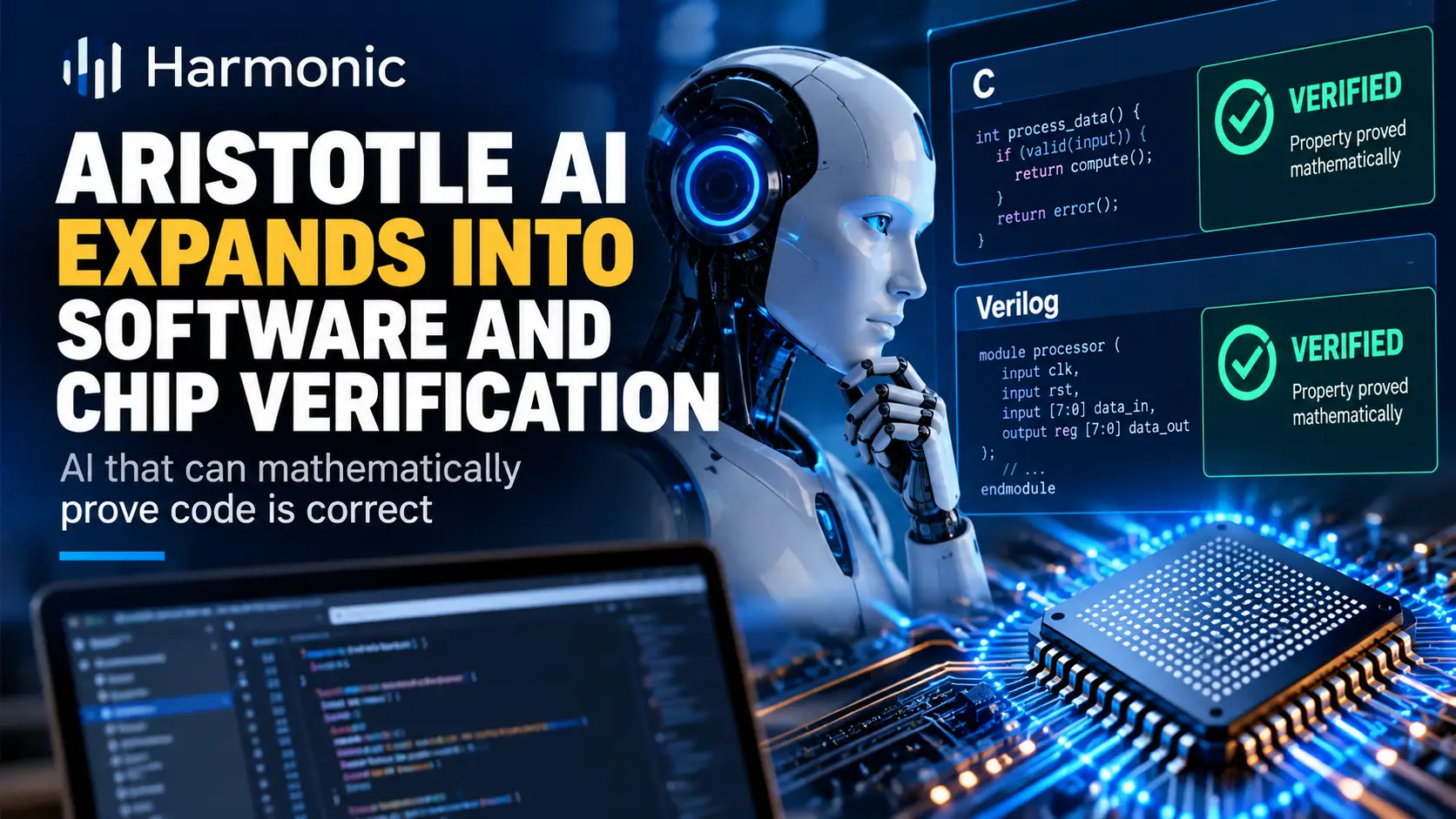
Harmonic is taking its Aristotle artificial intelligence system beyond mathematical research and into software and semiconductor engineering.
On October 27, 2026, the company announced that Aristotle can now formally verify selected properties of software written in C and hardware designs written in Verilog. The move comes as AI coding tools make it easier to produce software—and harder for engineering teams to review everything they generate.
Unlike an ordinary AI coding assistant that predicts code or recommends fixes, Aristotle is designed to work with machine-checked mathematical proofs. The goal is to give engineers stronger evidence that critical requirements hold, not simply confidence that a program passed a collection of tests.
The announcement is important for developers, cybersecurity professionals, chip designers, and businesses that depend on reliable software. But there is an essential limitation: a formal proof only establishes what has been correctly specified and proved under its stated assumptions. It is not a blanket guarantee that an entire application is free of defects.
What did Harmonic announce on October 27, 2026?
Harmonic announced an expansion of its Aristotle AI platform from mathematical theorem proving into formal verification for two engineering languages:
- C: A programming language widely used in operating systems, embedded devices, performance-sensitive libraries, and infrastructure software.
- Verilog: A hardware description language used to describe and design digital circuits, including components of semiconductor chips.
According to Harmonic, Aristotle can analyze code, suggest properties worth checking, attempt proofs, and explain which properties were proved, refuted, or left unresolved. Engineers can review those properties and their assumptions, then integrate recurring verification checks into a continuous integration (CI) pipeline.
The company says the service is available through Aristotle’s website with consumption-based pricing. Enterprise arrangements include additional deployment and support options.
What is formal verification?
Formal verification uses mathematics and logic to determine whether a system satisfies precisely defined requirements. Rather than running only a selected set of test inputs, a proof can establish a property for all inputs and states covered by a valid mathematical model and its assumptions.
For example, a developer might want to establish that a function never reads outside a buffer, that a payment calculation preserves a specified accounting invariant, or that a hardware controller never enters a forbidden state.
Traditional testing remains valuable. A unit test can show that a function returns the expected result for particular examples. Formal verification can go further by proving that a defined property holds across an entire modeled set of cases.
| Approach | What it does | Key limitation |
|---|---|---|
| Manual code review | Engineers inspect code for errors, maintainability, and security concerns. | Human reviewers can miss subtle interactions and edge cases. |
| Automated testing | Runs code against selected scenarios and expected results. | Passing tests does not cover every possible input or state. |
| Static analysis | Examines source code without necessarily executing it. | Findings and coverage depend on the analysis technique. |
| Formal verification | Attempts to mathematically prove specified properties under stated assumptions. | Incorrect or incomplete specifications can leave important defects unaddressed. |
How does Aristotle’s verification workflow work?
Harmonic describes a workflow intended to make formal verification more accessible to ordinary engineering teams:
- Analyze the code: Aristotle examines a C program or Verilog hardware design.
- Propose properties: The system suggests statements about the code that engineers may want to verify.
- Attempt proofs: Aristotle tries to establish whether those statements hold under explicit assumptions.
- Review results: Engineers inspect what was proved, what failed, and what remains unresolved.
- Integrate with CI: Reviewed properties can be checked again as code changes are committed.
This human-review stage is critical. An AI system might prove an unimportant property perfectly while overlooking the requirement that actually matters to customers or security.
Why C and Verilog matter
C software: Security and low-level reliability
C is central to many software components where memory handling and performance are important. Errors involving pointers, arithmetic, buffer boundaries, or undefined behavior can cause crashes and sometimes create exploitable security vulnerabilities.
Harmonic says Aristotle can check specified functional requirements and the absence of certain classes of undefined behavior in C. The announcement does not establish that it detects every memory-safety flaw or supports every possible C codebase without limitations.
Verilog hardware: Finding costly design defects
Verilog describes digital hardware behavior. Errors can be particularly expensive when discovered after chip manufacturing, when a design correction may require substantial rework.
For Verilog, Harmonic highlights verification of control-path properties, including safety and liveness, and mathematical data-path properties. In practical terms, that could help designers verify that a controller avoids forbidden states, eventually completes specified operations, or calculates results according to a defined mathematical requirement.
What has Harmonic demonstrated so far?
Harmonic’s October 27 announcement cited two engineering examples:
- Tensordyne: Harmonic says Aristotle discovered bugs as deep as 110,000 cycles into a hardware design that the team considered particularly difficult to verify.
- LibTomMath: Harmonic says Aristotle fixed three bugs in the multiprecision arithmetic library and improved modular-exponentiation performance by 31%–38% in the company’s benchmarks, while proving the optimized code against the same specification.
LibTomMath is used in software projects including Tcl and Dropbear SSH, making the case study relevant to software infrastructure and security.
Important context: These are examples and benchmark figures reported by Harmonic. They should not be treated as an independent guarantee that Aristotle will achieve comparable results in other projects.
What is the connection to recent PHP vulnerabilities?
Reuters reported that researchers recently used Aristotle-related technology to identify critical flaws in PHP, prompting efforts to patch the vulnerabilities. That connection is especially relevant to developers and hosting administrators because PHP powers much of the WordPress ecosystem.
However, Aristotle’s newly announced commercial verification support begins with C and Verilog—not PHP source code as a supported language in the same sense. PHP’s interpreter and core components are implemented largely in C, which helps explain why C-level analysis matters to the security of PHP-based websites.
For WordPress administrators, this does not mean Aristotle can currently be installed as a plugin to formally verify a WordPress site, theme, or PHP plugin. It also does not replace applying security patches or checking server configurations.
Could Aristotle change AI-assisted software development?
AI coding assistants have made it easier to generate functions, tests, documentation, and application prototypes. But generating code quickly does not establish that the code behaves correctly under unusual inputs, unexpected states, or malicious conditions.
Formal verification could become an important complementary step. Instead of asking only, “Can an AI write this function?” engineering teams may increasingly ask, “Can we prove the critical property that this function must preserve?”
This is particularly promising for high-assurance systems such as cryptographic libraries, firmware, chip control logic, industrial systems, and components that process sensitive data.
Still, several practical questions remain unanswered by the announcement: How much human effort is required to validate proposed properties? How well does the platform scale to large legacy codebases? Which language features and third-party dependencies are supported? How much does verification cost for typical teams?
What does this mean for WordPress and PHP developers?
WordPress development is not the primary target of the October 27 product release, but the underlying lessons are directly relevant to developers building plugins, themes, integrations, and custom business applications.
1. Define requirements before generating code
When asking an AI assistant to write PHP or JavaScript, describe what the code must always do—and what it must never do. Examples include permission checks, nonce validation, input sanitization, output escaping, and safe handling of user-controlled data.
2. Keep human review in the development process
AI-generated code should still undergo code review, testing, and security analysis. An AI assistant’s confident explanation is not a proof of correctness.
3. Add automated checks to CI
For WordPress projects, teams can use PHPUnit, PHPStan or Psalm where appropriate, WordPress Coding Standards, JavaScript tests, and security scanning in GitHub Actions or another CI platform. These are practical tools available today, even without formal verification.
4. Treat specifications as security controls
For critical workflows, write down invariants such as “a user without the required capability cannot change this setting” or “a refund cannot exceed the authorized amount.” Tests can then be designed to challenge those invariants, and suitable formal methods may eventually provide stronger guarantees for selected components.
5. Continue ordinary patching and hardening
Formal verification does not eliminate the need to update WordPress core, plugins, themes, PHP runtimes, and server software. Secure deployment, access controls, backups, and monitoring remain necessary.
Can formal verification eliminate software vulnerabilities?
No. It can provide strong assurance for carefully specified properties, but several limitations remain:
- Specification errors: A proof can be valid while the requirement being proved is incomplete or wrong.
- Assumptions: Proofs may rely on conditions that do not hold in a deployed environment.
- System boundaries: Verified code can interact with unverified libraries, services, hardware, or configuration.
- Operational security: Stolen credentials, insecure deployment settings, and social engineering are not solved merely by proving code properties.
- Verification cost: Complex systems may still require specialist knowledge, computation, and significant engineering effort.
Formal verification is therefore best viewed as another layer of assurance alongside testing, review, threat modeling, and operational security—not as a universal replacement.
Frequently asked questions
What is Harmonic Aristotle AI?
Aristotle is an AI-based mathematical reasoning and formal-verification system developed by Harmonic. As of October 27, 2026, Harmonic says it supports verification of selected properties in C software and Verilog hardware designs.
What is the difference between Aristotle and a normal AI coding assistant?
A conventional coding assistant primarily generates or edits code. Aristotle’s new offering focuses on proposing and proving specified correctness properties using machine-checked reasoning. The tools address related but different engineering tasks.
Does Aristotle support PHP and WordPress plugins?
The newly announced formal-verification offering names C and Verilog as its initial supported languages. Harmonic has not announced equivalent direct verification support for arbitrary WordPress plugins or PHP applications in this release.
Can Aristotle find security vulnerabilities?
It may help identify certain defects or prove the absence of specified classes of problems within a defined model. It does not guarantee discovery of every vulnerability.
Can Aristotle verify an entire computer chip?
Harmonic describes verification capabilities for Verilog designs, including control and data-path properties. Whether a particular complete chip can be verified depends on the scope of its specifications, design complexity, assumptions, and tool capabilities.
Is Harmonic Aristotle available now?
Harmonic says Aristotle is available through its website with consumption-based pricing, alongside enterprise options. Users should consult the company for current pricing, eligibility, and technical limitations.
Conclusion: AI-generated code needs stronger evidence, not just faster output
Harmonic’s expansion of Aristotle into C and Verilog verification signals an important shift in AI software development: from generating more code toward establishing stronger evidence that critical code behaves as intended.
The announcement is promising, particularly for low-level software and hardware engineering, where subtle defects can be costly or dangerous. But the significance of the technology will depend on how well it performs in real production environments, how engineers validate its specifications, and whether teams can adopt it without excessive complexity or cost.
For WordPress and PHP developers, the immediate lesson is practical: use AI to accelerate development, but use clear requirements, testing, code review, and security controls to establish confidence in what gets deployed.
Sources and further reading
- Harmonic — Aristotle Expands Into Formal Verification for Software and Hardware, Starting With C and Verilog (October 27, 2026).
- Reuters — Robinhood CEO’s AI Startup Harmonic Expands Into Software, Chip Design Verification (October 27, 2026).
- Harmonic — Official Product Overview.
- SPLASH/ISSTA 2026 — Formal Verification of Hardware With an AI Theorem Prover.