
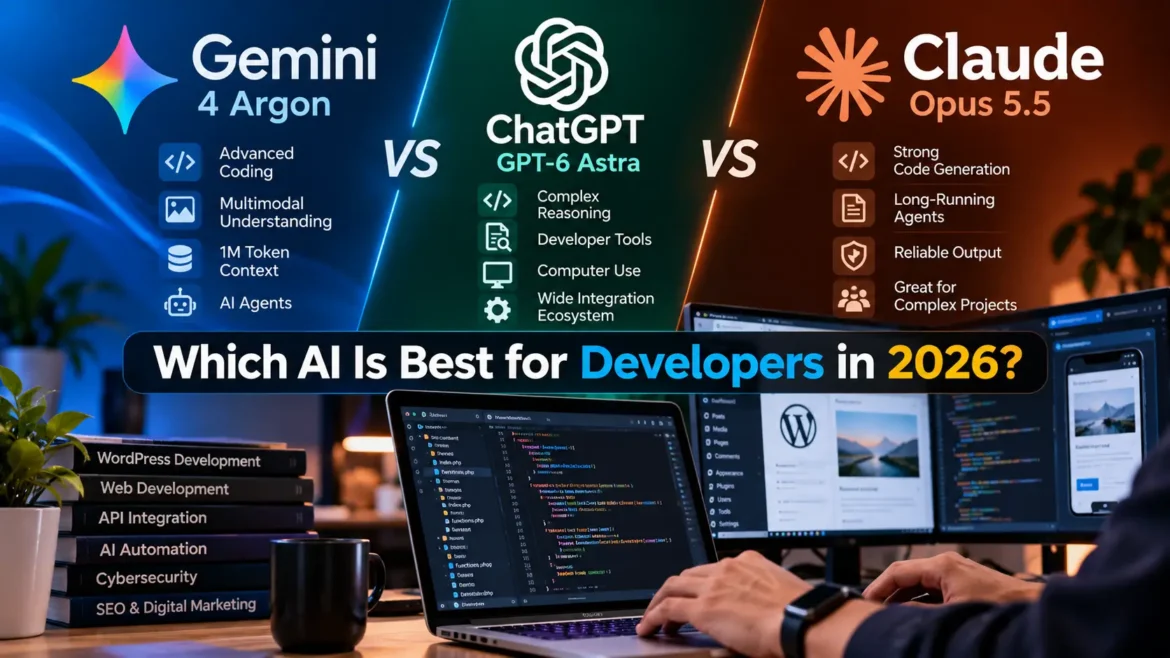
The competition between Google, OpenAI, and Anthropic has entered a new phase. Artificial intelligence is no longer just about answering questions, generating content, or suggesting a few lines of code. Today’s leading AI models can inspect large software projects, debug applications, use development tools, and carry out complex programming tasks.
Google’s reported release of Gemini 4 Argon in October 2026 has intensified the conversation about advanced reasoning, software engineering, multimodal understanding, and AI agents. But how does it compare with OpenAI’s ChatGPT and Anthropic’s Claude?
For developers, particularly those building WordPress websites, custom applications, APIs, and business automation systems, choosing the right AI assistant can affect productivity, development costs, and code quality. This guide compares the models and, more importantly, explains how to evaluate them on real development work.
Editor’s verification note (October 14, 2026): Model names, availability, published benchmark results and prices in this comparison should be checked against the vendors’ current official documentation before publication. The figures below are carried over from the draft and are not independently benchmarked by BongPico.com.
The Three AI Platforms Compared
ChatGPT, Gemini, and Claude are AI products; GPT-6 Astra, Gemini 4 Argon, and Claude Opus 5.5 are model names referenced in the source draft. Consumer subscriptions, API access, and development tools are separate offerings.
- Google Gemini 4 Argon: Presented as a model for advanced reasoning, coding, multimodal analysis, and agents.
- OpenAI GPT-6 Astra: Presented as a model for demanding reasoning, coding, computer use, and research.
- Anthropic Claude Opus 5.5 / Fable 5.1: Presented as options for development and longer-running agent workflows.
1. Gemini 4 Argon vs ChatGPT vs Claude: Key Specifications
| Feature | Gemini 4 Argon | GPT-6 Astra | Claude |
|---|---|---|---|
| Developer | Google DeepMind | OpenAI | Anthropic |
| Model in comparison | Gemini 4 Argon | GPT-6 Astra | Opus 5.5 / Fable 5.1 |
| Advanced reasoning | Yes | Yes | Yes |
| Agentic coding | Yes | Yes | Yes |
| Tool calling | Yes | Yes | Yes |
| Image understanding | Yes | Yes | Yes |
| Long context | Reported up to 1M tokens | Reported about 1.05M tokens | Model-dependent |
| Typical focus | Reasoning, agents, multimodal tasks | Coding, reasoning, computer use | Coding and agent workflows |
2. Coding Performance: Which AI Is Actually Better?
Developers use AI for far more than autocomplete. Modern coding assistants can investigate bugs, propose changes across multiple files, generate tests, explain unfamiliar codebases, and coordinate development tools.
The original comparison draft cited the following vendor-reported benchmark results. These numbers should not be treated as independent testing or a universal ranking.
| Model | DeepSWE v1.1 | FrontierSWE v2 | Terminal-bench 4.0 |
|---|---|---|---|
| Gemini 4 Argon | 77.9% | 55.0% | 57.4% |
| GPT-6 Astra | 74.1% | 65.5% | 58.2% |
| Claude Fable 5.1 | 67.4% | 56.3% | 57.9% |
| Claude Opus 5.5 | 74.2% | 62.3% | 66.4% |
The broader lesson is that coding performance depends on the task. A model that performs well on repository-level changes may not be strongest at command-line operations, debugging, or infrastructure work.
3. Gemini 4 Argon: A Candidate for Large and Multimodal Projects
Gemini 4 Argon is described in the draft as a high-capability model with a large context window and support for text, images, audio, video, and PDF analysis, alongside function calling and other developer tools.
Where Gemini Could Help
Consider migrating a legacy WordPress site from a custom PHP theme to Elementor. The project may include templates, custom fields, JavaScript, CSS, plugins, and technical documentation. A long-context model could help review the codebase, identify dependencies, and propose a migration plan.
Multimodal input can also help developers explain problems using screenshots, error messages, and source code together. However, accepting large inputs does not guarantee that the model will understand every dependency correctly.
Limitations
Large reasoning workloads can take time and consume substantial tokens. For a small CSS fix or simple PHP function, a faster, cheaper model may be more economical. Check the current API tier and feature availability before selecting the model.
4. ChatGPT: A Strong Option for Mixed Development Workflows
ChatGPT is useful when software work combines programming, troubleshooting, planning, research, and documentation. Developers often need more than a code snippet: they need to understand the cause of an issue, test the solution, and explain the change to a client.
For a WordPress project using Elementor, custom fields, and a third-party API, a developer could use ChatGPT to:
- Investigate why a dynamic field is not rendering.
- Review PHP hooks and shortcode logic.
- Generate JavaScript for interactive components.
- Analyze API responses and propose error handling.
- Write testing instructions and deployment notes.
- Prepare technical documentation.
Its suitability for a specific job still depends on the model and tools used. ChatGPT subscriptions and API billing are separate, and access to one does not imply unrestricted access to the other.
5. Claude: A Candidate for Repository-Level Coding and Agents
Claude is another option worth evaluating for code refactoring, testing, and multi-file development work. Agent-based workflows can help coordinate changes that touch PHP, JavaScript, database queries, and automated tests.
For example, a developer maintaining a custom WordPress plugin could ask an AI coding agent to review the architecture, propose a new REST API endpoint, generate tests, and investigate test failures.
The developer must still verify the changes in a controlled environment. Long-running agents can make mistakes, call tools unnecessarily, or modify files beyond the intended scope if permissions are too broad.
6. API Pricing: Which Model Offers Better Value?
API costs matter when building production applications, internal tools, or automated workflows. The following rates were included in the source draft and must be rechecked before publication.
| Model | Input per 1M tokens | Output per 1M tokens |
|---|---|---|
| Gemini 4 Argon (reported introductory rate) | $2 | $10 |
| Gemini 4 Argon (reported Dec. 1 rate) | $4 | $20 |
| GPT-6 Astra | $10 | $50 |
| Claude Fable 5.1 | $10 | $50 |
Example Cost Calculation
Suppose a workflow uses one million input tokens and 200,000 output tokens. Using the draft rates above, the estimated token charges would be:
- Gemini 4 Argon (introductory): $4.00
- Gemini 4 Argon (later rate): $8.00
- GPT-6 Astra: $20.00
- Claude Fable 5.1: $20.00
These figures are simple calculations, not live quotes. Lower token pricing does not automatically mean a cheaper completed task. A model that needs several retries or produces incorrect code may cost more overall.
7. Which AI Is Best for WordPress Developers?
WordPress development often involves PHP, Elementor, custom fields, JavaScript, CSS, REST APIs, hosting, security, analytics, and third-party integrations. The right assistant should help across these components without creating maintenance or security problems.
| Development task | Models worth testing first | Why |
|---|---|---|
| Elementor CSS and JavaScript fixes | ChatGPT or a lower-cost coding model | Quick iterations and explanations |
| Custom WordPress plugins | Claude or OpenAI coding models | Multi-file changes and test generation |
| Legacy theme migration | Gemini or another long-context model | Large codebases and mixed source materials |
| REST API and CRM integrations | OpenAI or Claude coding models | Complex application logic and error handling |
| Technical SEO audits | Gemini or ChatGPT | Technical and marketing data analysis |
Example: Debugging an Elementor Loop Grid
Suppose an Elementor Loop Grid displays incorrect custom field values. Give each model the same PHP snippet, field configuration, error logs, expected output, and WordPress version. Compare whether it identifies the root cause, generates compatible code, avoids security issues, and explains how to test the fix.
Working code matters more than confident explanations.
8. AI Agents: The Next Major Competition
AI development is moving from chat-based assistance toward agents that can work through a sequence of related tasks. For example, an agent working in an authorized staging environment could inspect a failing API integration, read relevant logs, propose changes, and run available tests.
- Developer defines the task: Fix a failing API integration on staging.
- Agent inspects relevant code: Read permitted files and configurations.
- Agent analyzes error logs: Identify likely failure points.
- Agent proposes changes: Prepare a reviewable patch.
- Agent runs available tests: Check whether the issue is resolved.
- Human reviews and approves: Validate security and production readiness.
The effectiveness of this workflow depends not only on the model, but also on the coding environment, available tools, access permissions, and test coverage.
9. Which AI Is Best for SEO and Digital Marketing Developers?
Developers who also handle marketing may need to analyze Search Console data, investigate website performance, review conversion tracking, and automate reports.
Gemini for Large-Scale Analysis
A long-context, multimodal model could help analyze exported search performance data alongside crawl reports, screenshots, and technical documentation.
ChatGPT for Technical and Business Communication
ChatGPT can help connect coding, analytics interpretation, documentation, and client-facing explanations in one workflow.
Claude for Code-Heavy Automation
Claude is worth testing for custom reporting applications, API integrations, and repeated automation tasks involving code changes.
None of these models automatically has access to Google Analytics, Search Console, or WordPress without appropriate integrations and permissions. Using a particular AI model does not itself improve search rankings.
10. How Developers Should Test the Three AI Models
Rather than choosing based on marketing claims, run a small evaluation using real projects. Give each model the same task, context, constraints, and acceptance criteria.
| Evaluation criterion | Suggested weight |
|---|---|
| Code correctness | 35% |
| Security | 25% |
| Debugging accuracy | 20% |
| Speed and efficiency | 10% |
| Documentation quality | 10% |
Test at least one PHP task, one JavaScript task, one debugging problem, and one multi-file project. Record the actual time spent, number of retries, cost, and quality of the final code.
11. The Biggest Limitations of AI Coding Assistants
- Incorrect code: AI can generate plausible code that fails under real conditions.
- Security problems: Generated code may omit authorization checks or mishandle input.
- Outdated assumptions: A model may suggest deprecated functions.
- Incomplete context: Even long-context systems can miss dependencies.
- Agent mistakes: Tools may make unintended changes.
- Unpredictable costs: Repeated reasoning and tool calls can increase usage.
Use version control, staging environments, automated tests, least-privilege permissions, and human code review. Protect confidential client code and personal data when using external AI services.
12. Final Verdict: Which AI Should Developers Choose in 2026?
There is no universal winner. The right choice depends on the work being done.
Gemini: Worth Testing for Large and Multimodal Projects
Its reported large context window and multimodal capabilities make it an interesting candidate for complex development experiments, subject to verification of current access and pricing.
ChatGPT: Useful for Mixed Development and Business Workflows
ChatGPT is a practical option when coding, debugging, technical research, analytics, and documentation are all part of the job.
Claude: Worth Testing for Repository-Level Coding and Agent Workflows
Claude is another strong candidate for sustained coding tasks, refactoring, and multi-step development work.
Should Developers Subscribe to All Three?
Not necessarily. For many independent developers, one primary AI assistant and access to a second model for difficult tasks may be sufficient. Agencies may prefer API-based workflows when they need control over integrations, usage, and costs.
The best AI for developers is the one that produces reliable, secure, maintainable results on their actual projects—not simply the one with the highest advertised benchmark.
Frequently Asked Questions
Is Gemini 4 Argon better than ChatGPT for coding?
No universal winner has been established. Coding results depend on the task, tools, and evaluation method. Compare both on your own development problems.
Is Claude better than Gemini for WordPress development?
There is no reliable WordPress-specific result proving one is always better. Test plugin development, PHP debugging, and multi-file changes directly.
Which AI is cheapest for developers?
Compare current API rates and the cost of completing an entire task. Less expensive models may be more economical for routine work, even when premium models are more capable.
Can AI build an entire WordPress website?
AI can assist with templates, plugins, styling, JavaScript, and integrations. Production websites still require security checks, testing, hosting configuration, content review, and maintenance.
Will AI replace web developers?
AI is automating parts of development, but developers remain responsible for architecture, integrations, quality, security, and business outcomes. Long-term employment effects are uncertain.
Which AI is best for beginners?
ChatGPT, Gemini, and Claude all provide conversational experiences. Beginners should prioritize clear explanations, ease of use, and affordable access.
Official Sources and Further Reading
- Google AI for Developers — Gemini model documentation
- Google Gemini API pricing
- OpenAI API model documentation
- OpenAI API pricing
- Anthropic Claude model overview
- Anthropic pricing
Disclosure: This is an editorial comparison of AI development platforms, not an independent laboratory benchmark. Model capabilities, availability, and prices can change.