
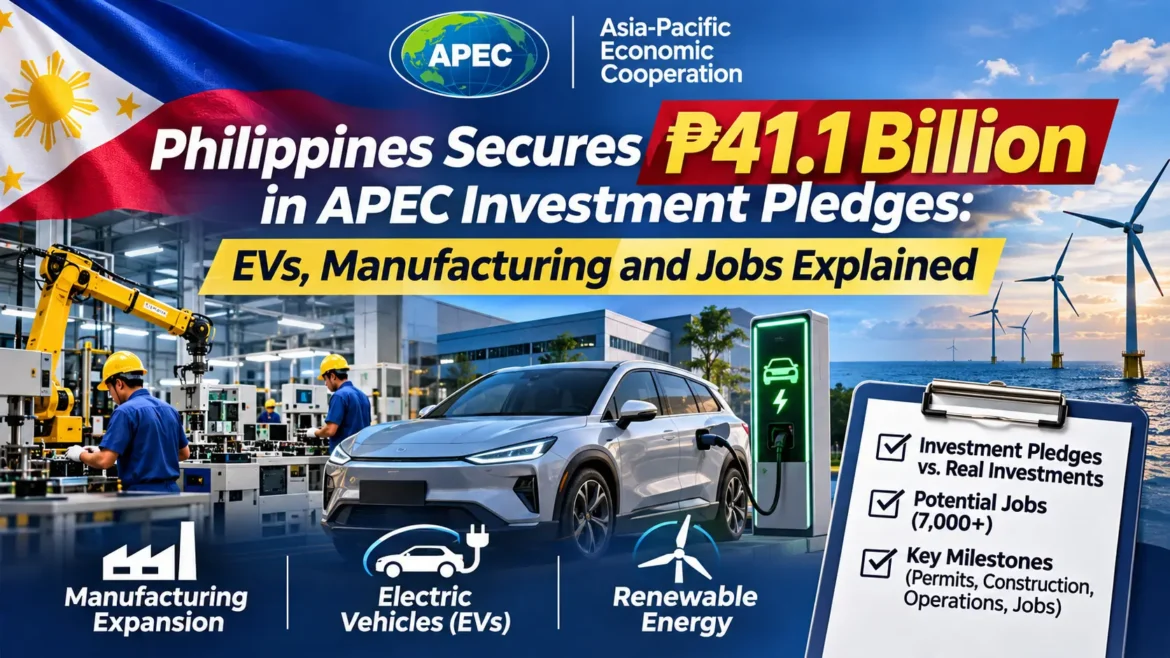
The Philippines has announced ₱41.1 billion in investment pledges following President Ferdinand Marcos Jr.’s participation in the 33rd Asia-Pacific Economic Cooperation (APEC) Economic Leaders’ Meeting in Shenzhen, China, in November 2026.
The announced investment opportunities cover manufacturing, electric vehicles (EVs), automotive components, electronics, construction materials, and renewable energy. Government officials estimate that the proposed projects could generate more than 7,000 jobs for Filipino workers.
For an economy seeking stronger manufacturing activity, additional exports, and higher-quality employment, the announcement is encouraging. However, there is an important distinction between attracting investment commitments and receiving actual investment capital.
The ₱41.1 billion represents announced investment pledges, not money already invested in Philippine factories or businesses. These projects must still move through financing, regulatory approvals, construction, and commercial operations before their full economic benefits can be measured.
This article examines the companies involved, the industries expected to benefit, the potential impact on Filipino workers, and the milestones that will determine whether these announcements produce lasting economic gains.
What Happened During the 2026 APEC Meeting?
President Marcos attended the 33rd APEC Economic Leaders’ Meeting in Shenzhen, where he held discussions with regional leaders and executives from major Chinese companies.
During his November 20 arrival statement, Marcos discussed investment opportunities identified during his business engagements. The administration emphasized manufacturing expansion, employment generation, stronger exports, supply-chain development, and technology transfer.
These priorities reflect the Philippines’ ambition to become a more competitive manufacturing destination in Southeast Asia.
However, an important reporting discrepancy remains. The official Presidential Communications Office transcript records a figure of USD 41.1 billion, while several Philippine news organizations reported ₱41.1 billion.
These are substantially different amounts. This article uses the peso figure reported by Philippine news outlets, but clarification from the government is necessary before treating it as a fully reconciled official total.
Which Companies and Industries Are Involved?
The announced business engagements involved companies operating in industrial manufacturing, automotive technology, electronics, building materials, and renewable energy.
| Company | Industry | Reported Engagement |
|---|---|---|
| C&U Group | Bearings and automotive components | Proposed manufacturing facility in Batangas |
| BYD | Electric vehicles | Discussions on expanding Philippine operations and EV development |
| Ming Yang Smart Energy | Renewable energy | Potential offshore wind infrastructure investments |
| TCL Group | Electronics | Manufacturing expansion opportunities |
| Huaxin Building Materials Group | Construction materials | Industrial investment discussions |
| Shenzhen Grandsun Electronic | Electronics manufacturing | Potential manufacturing expansion |
| PCON International | Industrial investment | Participation in business investment discussions |
The reported total should not be interpreted as confirmation that every participating company has signed a final investment agreement.
Likewise, no complete, independently verified company-by-company breakdown of the ₱41.1 billion figure was available in the cited announcements.
1. Manufacturing: A Potential Boost for Philippine Industry
One of the more concrete investment announcements involves C&U Group, a Chinese manufacturer of bearings and related industrial components.
The company discussed establishing a fully integrated manufacturing facility in Alitagtag, Batangas, with a reported initial investment commitment of approximately US$87 million.
The proposed first phase would cover roughly 20 hectares.
If completed as envisioned, the facility could become C&U Group’s largest manufacturing base outside China and its only manufacturing facility in Southeast Asia.
Why a Bearings Factory Matters
Bearings are essential components used in vehicles, industrial equipment, electric motors, and manufacturing machinery.
A large production facility could create demand for:
- Mechanical and industrial engineers
- Machinists and machine operators
- Quality-control inspectors
- Maintenance technicians
- Warehouse and logistics personnel
- Production supervisors and administrative workers
Beyond direct employment, the project could generate opportunities for Philippine businesses supplying metalworking services, packaging, maintenance, logistics, and industrial support.
However, the project’s actual contribution will depend on how much production and sourcing take place locally.
A factory that imports most components and performs limited assembly may create jobs but deliver less domestic economic value than one that develops a broad network of Philippine suppliers.
What Should Be Monitored?
Important project milestones include confirmed land arrangements, investment registration, environmental permits, construction contracts, equipment installation, hiring, and the start of commercial production.
A proposed factory is an encouraging first step. An operating factory with sustained employment is stronger evidence of realized investment.
2. Electric Vehicles: Could BYD Help Build a Philippine EV Industry?
Electric vehicles were another major topic during the APEC business engagements.
President Marcos met with representatives of Chinese automotive manufacturer BYD to discuss opportunities to expand the company’s presence in the Philippines.
BYD already operates in the Philippine automotive market through its partnership with Ayala Corporation’s ACMobility.
The latest discussions explored potential opportunities involving electric mobility, automotive supply chains, and local industry development.
However, the meeting should not be interpreted as confirmation that BYD has finalized plans to build a new vehicle assembly factory in the Philippines.
Why Local EV Manufacturing Matters
Electric vehicle adoption has been increasing in the Philippines, but higher vehicle sales do not automatically create a domestic automotive manufacturing industry.
Imported vehicles can support cleaner transportation and provide consumers with additional choices. Local manufacturing could offer broader industrial benefits.
These may include:
- New vehicle assembly operations
- Local automotive component manufacturing
- Additional engineering and technical employment
- Battery-related services and electrical systems development
- Opportunities for Philippine parts suppliers
- More demand for industrial logistics and maintenance
The Department of Energy reported that at least 66,685 electric and hybrid vehicles were sold in the Philippines from January through August 2026.
These represented approximately 24.7% of estimated vehicle sales during that period.
The figure includes conventional hybrids, plug-in hybrids, and battery-electric vehicles. It should not be interpreted as the market share of fully electric vehicles alone.
Government Incentives for Local EV Production
The Philippine government established the Electric Vehicle Incentive Strategy (EVIS) under Executive Order No. 121 in July 2026.
The program provides performance-based incentives designed to encourage qualifying manufacturers to produce electric and hybrid vehicles, parts, and components locally.
Its framework includes an overall incentive ceiling of ₱60 billion, along with investment and production requirements.
Qualifying manufacturers generally must meet specified capital investment and production targets.
These incentives could improve the Philippines’ competitiveness when attracting automotive manufacturers.
Nevertheless, the existence of the EVIS program does not mean that BYD or any other particular company has already secured incentives or committed to a new manufacturing plant.
Will Electric Vehicles Become Cheaper?
Local manufacturing could potentially reduce some production and logistics costs.
The Department of Energy has estimated that expanded local EV manufacturing and assembly could help lower prevailing EV prices by approximately 6% to 12%, depending on production arrangements.
However, that estimate is not a guaranteed retail price reduction.
Actual consumer prices will depend on production volumes, imported components, currency exchange rates, taxes, distribution costs, and market competition.
For Filipino motorists, the strongest evidence of progress would be locally manufactured EV models reaching dealerships at competitive prices, backed by dependable charging infrastructure and after-sales services.
3. Renewable Energy: Offshore Wind Investment Opportunities
The President also met with representatives of Ming Yang Smart Energy Group to discuss potential offshore wind infrastructure investments.
Offshore wind could help diversify the Philippine energy mix and reduce long-term dependence on imported fossil fuels.
It could also support local business opportunities in:
- Marine construction and engineering
- Wind turbine components
- Port and logistics infrastructure
- Electrical installation and maintenance
- Technical training and workforce development
However, offshore wind projects require significant capital and complex implementation.
Before generating electricity, a project may need to complete wind-resource assessments, environmental studies, maritime coordination, grid connection planning, financing, equipment procurement, and construction.
An investment discussion alone does not establish that a wind farm has secured full financing or is ready to supply electricity.
Why Renewable Energy Matters to Manufacturing
Reliable and competitively priced electricity is an important consideration for industrial investors.
Manufacturers must account for energy expenses when selecting production locations.
Improvements in electricity supply and grid reliability could therefore support the broader manufacturing ambitions discussed during APEC.
However, lower electricity prices should be treated as a possible longer-term benefit, not an automatic result of renewable energy investment announcements.
4. Electronics and Building Materials: Opportunities Beyond Electric Vehicles
The investment engagements also included TCL Group, Huaxin Building Materials Group, Shenzhen Grandsun Electronic, and PCON International.
These companies represent opportunities in electronics production, industrial equipment, construction materials, and related manufacturing activities.
Electronics Manufacturing
The Philippines already participates in international electronics supply chains.
Additional manufacturing activity could create demand for electronics engineers, production technicians, quality-control specialists, industrial facilities, and local suppliers.
Potential benefits include greater production capacity, increased export activity, and opportunities for Filipino technical workers.
Building Materials
New building-materials production facilities could potentially support infrastructure development and domestic construction supply chains.
Local manufacturing may reduce some import requirements, although any cost advantage would depend on production efficiency, raw materials, energy costs, logistics, and competition.
At this stage, the public announcements do not provide enough project-level information to quantify the benefits expected from every participating company.
5. What Does ₱41.1 Billion in Investment Pledges Actually Mean?
One of the most important distinctions in economic reporting is the difference between an investment pledge and actual capital entering the economy.
An investment announcement can represent genuine business interest, but it may still be subject to negotiations, feasibility studies, financing, and regulatory approvals.
The Stages of an Investment Project
- Investment announcement: A company expresses interest in establishing or expanding business operations.
- Formal project commitment: Investment amounts, commercial agreements, and project responsibilities become more specific.
- Regulatory approvals and financing: The project obtains relevant permits, registrations, and financing arrangements.
- Capital deployment and construction: Money is spent on land, equipment, facilities, labor, and other project requirements.
- Commercial operations: The facility begins producing goods or delivering services.
- Sustained economic benefits: Jobs, wages, exports, supplier purchases, and tax contributions can be measured over time.
Not every announced investment progresses through all these stages.
Some projects are delayed, reduced in scope, or canceled because of changing economic conditions.
Pledged Investment Versus Approved Investment
Suppose a company announces plans to build a ₱10 billion manufacturing facility.
The company may subsequently obtain approval from the Board of Investments or another investment promotion agency.
That approval represents a significant administrative milestone, but it does not mean the entire ₱10 billion has already been spent.
Similarly, foreign direct investment statistics measure financial transactions under defined statistical rules. These figures are not interchangeable with headline investment pledges.
A ₱41.1 billion pledge should not be reported as ₱41.1 billion already injected into the Philippine economy.
6. More Than 7,000 Jobs: What Could Filipino Workers Expect?
The government estimates that the announced investment opportunities could create more than 7,000 jobs.
If the projects proceed, employment opportunities could emerge in manufacturing, automotive technology, renewable energy, construction, engineering, and logistics.
| Industry | Potential Jobs |
|---|---|
| Automotive manufacturing | Assembly workers, mechanical engineers, automotive technicians |
| Precision manufacturing | Machinists, quality inspectors, maintenance specialists |
| Electronics | Electronics engineers, production technicians, testing personnel |
| Renewable energy | Electrical engineers, marine technicians, project specialists |
| Construction | Civil engineers, equipment operators, construction workers |
| Logistics | Warehouse staff, supply-chain coordinators, transport personnel |
These are examples of occupations that the projects could support, not a confirmed allocation of the announced 7,000-plus positions.
How Much Investment Does Each Potential Job Represent?
Dividing ₱41.1 billion by 7,000 potential jobs produces an illustrative ratio of approximately ₱5.87 million in pledged investment per job.
Because the announcement refers to more than 7,000 jobs, the ratio would be lower if additional positions materialize.
This figure should not be interpreted as a direct cost of creating each job.
Industrial projects frequently require substantial spending on machinery, land, equipment, buildings, and other capital assets.
Job Quality Matters
The economic benefit should be evaluated using more than the number of announced positions.
Important measures include:
- Actual number of Filipino workers hired
- Wages and employment benefits
- Permanent versus temporary employment
- Skills development and training
- Workplace safety and employment stability
- Opportunities for promotion into technical and management positions
Government reporting should also distinguish temporary construction employment from permanent operational jobs.
7. How Will Small Philippine Businesses Benefit?
Large industrial investments can generate opportunities for micro, small, and medium enterprises (MSMEs), particularly when international manufacturers purchase goods and services from domestic suppliers.
Potential beneficiaries include businesses providing industrial maintenance, metal fabrication, packaging, transportation, warehousing, information technology, equipment servicing, and employee support services.
However, these opportunities are not automatic.
Foreign manufacturers may initially depend on established overseas suppliers, especially when specialized components require strict quality standards and certifications.
To increase Philippine participation, businesses may need access to supplier-development programs, technical assistance, financing, and industry-specific training.
Useful indicators would include the number of Filipino suppliers receiving contracts and the total value of local procurement.
8. How Significant Is ₱41.1 Billion Compared With Other Investment Figures?
The APEC announcement should be evaluated within the broader Philippine investment environment.
November 2026 reporting indicated that the Board of Investments, Philippine Economic Zone Authority, and Bases Conversion and Development Authority had recorded approximately ₱1.398 trillion in combined investment approvals during the first ten months of 2026.
The ₱41.1 billion APEC pledge figure is equivalent to approximately 2.9% of that broader amount.
However, these are different investment measures covering different reporting periods.
Approved investments and announced pledges should not be treated as equivalent, and the figures should not simply be added together.
Some projects announced during APEC may also overlap with investments previously disclosed or registered through other government channels.
Project-level verification would be needed to determine whether the commitments represent entirely new investments.
9. What Could Prevent the Investments From Materializing?
Investment announcements can fail to become operating projects for several reasons.
Electricity Costs and Reliability
Manufacturers require dependable electricity and competitive energy costs. Unexpected increases can weaken a project’s financial outlook.
Infrastructure and Logistics
Ports, roads, industrial parks, and transport systems influence the cost of moving raw materials and finished products.
Regulatory Delays
Land-use approvals, environmental requirements, construction permits, and other administrative processes can slow implementation.
Financing and Market Demand
Companies may postpone or reduce projects if financing becomes more expensive or expected market demand weakens.
Skills Availability
Advanced manufacturing requires trained technicians, engineers, and production specialists. A shortage of qualified workers can delay operations.
Trade and Geopolitical Risks
Changes in tariffs, export restrictions, international relations, and supply-chain strategies may influence investment decisions.
These are general risks affecting large investment projects, not evidence that any particular company involved in the APEC engagements is currently experiencing these problems.
10. The Milestones That Will Prove Whether APEC Investment Pledges Deliver Results
The most useful way to evaluate the announcement is through transparent project monitoring.
Instead of reporting only the original pledge amount, government agencies should provide regular updates on actual progress.
| Milestone | Evidence of Progress |
|---|---|
| Signed project agreements | Identified investors, investment amounts, and defined project scope |
| Regulatory approvals | Confirmed registrations, permits, and clearances |
| Financing | Documented funding arrangements or financial close |
| Construction | Site preparation, buildings, and equipment installation |
| Capital deployment | Actual project expenditures and investment flows |
| Hiring | Verified Filipino workers employed |
| Commercial operations | Factories producing goods or projects delivering services |
| Exports and local procurement | International sales and contracts awarded to Philippine suppliers |
A Practical Investment Monitoring Timeline
First 3–6 months: Look for formal project announcements, company-level investment allocations, confirmed sites, registration applications, and financing progress.
Within 6–12 months: Monitor permitting, construction contracts, site development, equipment orders, and initial hiring.
Within 12–24 months: For projects with relatively short development cycles, look for construction progress, production trials, supplier agreements, and additional employment.
Within 24–36 months and beyond: Track operational facilities, sustained jobs, exports, local procurement, and the proportion of pledged investment actually realized.
These are suggested review periods, not official project deadlines. Large industrial developments and offshore wind projects may take considerably longer.
Who Should Report the Progress?
The Department of Trade and Industry, Board of Investments, relevant investment promotion agencies, and participating companies would be important sources of project updates.
For renewable energy projects, the Department of Energy and relevant regulators would also play key roles.
Independent reporting should compare these announcements with company disclosures, construction activity, employment statistics, and official investment data.
11. What Would Successful Investment Actually Look Like?
The success of the APEC business engagements should not depend entirely on whether the full ₱41.1 billion is eventually realized.
The quality and long-term contribution of each project also matter.
In manufacturing, success could mean a precision-components facility in Batangas employing Filipino technical workers, purchasing inputs locally, and exporting products to international customers.
In electric vehicles, it could mean new local assembly or component manufacturing operations supported by skilled employees and domestic suppliers.
For renewable energy, progress would mean projects securing financing, completing construction, and eventually supplying electricity to the grid.
Across these sectors, the strongest results would include sustained employment, increased industrial capabilities, technology transfer, higher exports, and greater participation by Philippine businesses.
12. Frequently Asked Questions
Has the Philippines Already Received ₱41.1 Billion From the APEC Investment Pledges?
No. The reported amount represents investment pledges announced after business engagements in Shenzhen. It should not be treated as money already received or spent in the Philippines.
Which Companies Were Involved?
The reported engagements included C&U Group, BYD, Ming Yang Smart Energy Group, TCL Group, Huaxin Building Materials Group, Shenzhen Grandsun Electronic, and PCON International.
Not all participating companies were identified as having signed final investment agreements.
Will BYD Build an Electric Vehicle Factory in the Philippines?
The November 2026 discussions explored opportunities to expand BYD’s Philippine operations and support EV industry development. The reported engagements do not establish a finalized new BYD manufacturing plant.
Where Will the Manufacturing Investments Be Located?
One specifically identified project is C&U Group’s proposed manufacturing facility in Alitagtag, Batangas. The complete geographic distribution of other proposed investments has not been established in the announcements reviewed.
Are the 7,000 Jobs Guaranteed?
No. The figure represents potential employment. Actual job creation will depend on project implementation, production requirements, and business conditions.
Will the Investments Reduce Electric Vehicle Prices?
Local EV production could potentially reduce some manufacturing and logistics costs. However, consumer prices will also depend on component sourcing, production scale, taxes, currency movements, competition, and other factors.
How Can the Public Verify the Investment Results?
The public can monitor official releases from the Department of Trade and Industry, Board of Investments, Department of Energy, Philippine Statistics Authority, and participating companies.
Important indicators include investment approvals, construction progress, actual capital deployment, hiring, exports, and commercial operations.
Conclusion: Investment Pledges Are Promising, but Implementation Is the Real Test
The Philippines’ reported ₱41.1 billion in APEC-related investment pledges represents an opportunity to expand manufacturing, strengthen automotive supply chains, develop renewable energy, and generate employment.
The engagements also suggest continuing investor interest in the country’s potential as a manufacturing and industrial destination in Southeast Asia.
However, the economic impact remains prospective.
The real measure of success will not be the amount announced after an international meeting. It will be the number of projects completed, the capital actually invested, the quality of jobs created, and the long-term value generated for Philippine businesses and workers.
For the government, the next challenge is to move from investment promotion to project execution—and to publish enough information for Filipinos to evaluate the results.
For investors and the public, the important question is no longer simply how much was pledged.
It is how much of that commitment will eventually become productive investment in the Philippine economy.
Sources and Further Reading
- Presidential Communications Office – November 20, 2026 Arrival Statement
- Philippine News Agency – APEC Investment Pledges Report
- GMA News – Philippines Secures ₱41 Billion in Investment Pledges
- Presidential Communications Office – Electric Vehicle Incentive Strategy
- Department of Energy – Electric Vehicle Adoption in the Philippines
Editorial note: Investment figures and employment projections reflect reported government announcements as of November 23, 2026. Actual investment realization and job creation may differ. The reported ₱41.1 billion amount also requires reconciliation with the USD 41.1 billion figure appearing in the official Presidential Communications Office transcript.