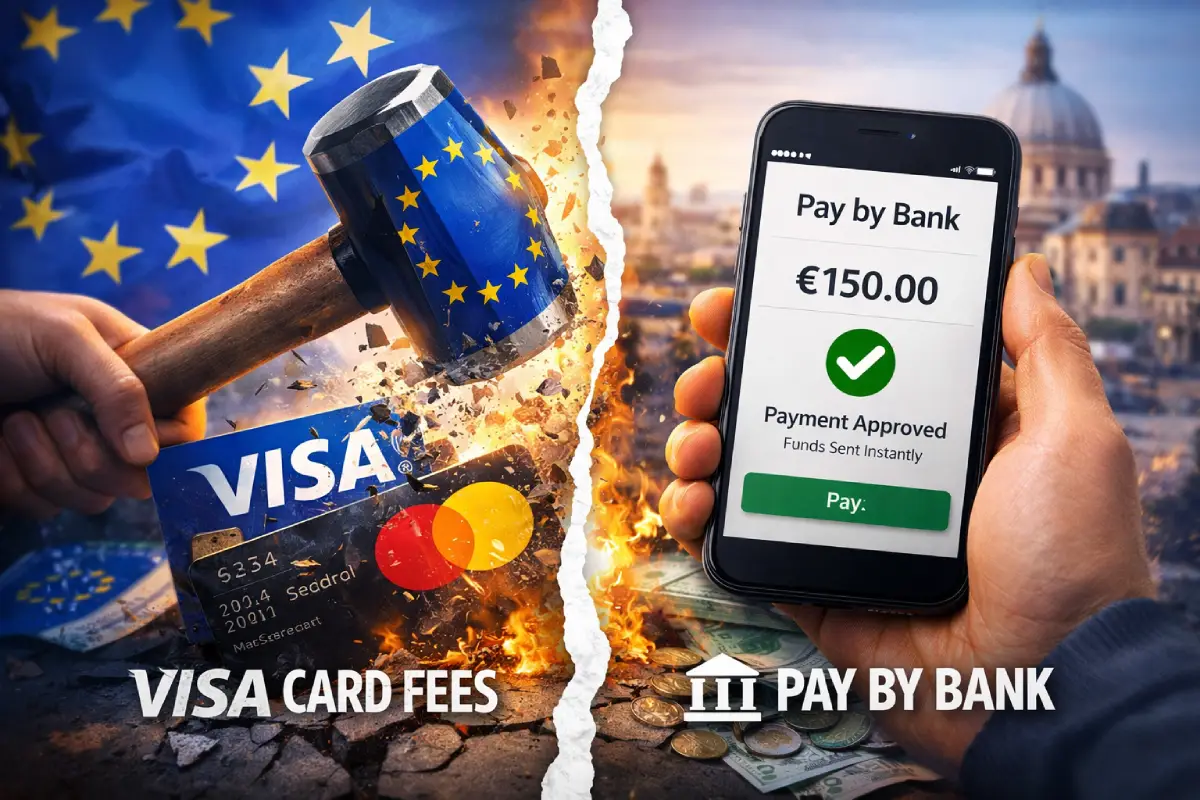
Brussels — Europe’s payments industry is entering a period of disruption, as a growing coalition of regulators, banks, and fintech firms push a new model that could weaken the long-standing dominance of Visa and Mastercard.
At the center of the shift is Pay by Bank, a payment method that allows consumers to transfer money directly from their bank accounts at checkout, bypassing card networks entirely. Backed by regulatory changes and supported by modern infrastructure, the model is gaining traction across the continent.
While still in its growth phase, Pay by Bank is already forcing businesses to reconsider how they accept payments—and how much they are willing to pay for it.
A System Built on Regulation
The foundation of Pay by Bank lies in the European Union’s PSD2, a regulation introduced to increase competition and innovation in financial services.
PSD2 requires banks to open their systems to licensed third-party providers through secure APIs. This allows fintech companies to initiate payments directly from a customer’s bank account, with the user’s consent.
In practical terms, it means that when a customer selects Pay by Bank at checkout, they are redirected to their banking app, where they authenticate the payment using familiar methods such as biometrics or one-time passwords. The funds are then transferred directly to the merchant.
This process eliminates several intermediaries that are central to card payments.
The Fee Gap Driving Adoption
For many businesses, the appeal of Pay by Bank comes down to cost.
Traditional card payments involve a layered fee structure. Even with European caps on interchange fees, merchants typically pay a combination of charges:
- Interchange fees to issuing banks
- Scheme fees to card networks
- Processing and acquiring fees
In total, these can range from 0.6% to 2.0% per transaction, depending on factors such as card type and transaction origin.
By contrast, Pay by Bank transactions are significantly cheaper.
Fintech providers such as TrueLayer, Tink, and GoCardless offer pricing models that typically fall between 0.1% and 0.5%, or fixed fees as low as €0.20 per transaction.
For high-volume merchants, the difference is material.
A company processing €1 million in monthly transactions could pay around €15,000 in card fees at a 1.5% average rate. Using Pay by Bank at 0.3%, that cost drops to roughly €3,000.
Example: Real Cost Impact
Let’s say a business processes €1 million/month:
- Card payments (1.5% avg):
→ €15,000 in fees - Pay by Bank (0.3% avg):
→ €3,000 in fees
👉 Savings: €12,000/month
👉 €144,000/year
That’s not optimization—that’s margin recovery. The annual savings—well into six figures—are driving serious attention from finance teams.
Side-by-Side Comparison
| Feature | Pay by Bank | Card (Visa/Mastercard) |
|---|---|---|
| Fee structure | Fixed or very low % | % of transaction |
| Average cost | 0.1% – 0.5% | 0.6% – 2.0% |
| High-value payments | Very cheap | Expensive |
| Chargebacks | Rare | Common |
| Settlement speed | Instant / near-instant | 1–3 days |
Structural Differences: Cards vs Direct Bank Payments
The cost disparity reflects a deeper structural difference between the two systems.
Card payments rely on a complex network of participants:
- The issuing bank (customer’s bank)
- The acquiring bank (merchant’s bank)
- The card network (Visa or Mastercard)
- Payment processors and gateways
Each layer introduces cost, complexity, and potential points of failure.
Pay by Bank simplifies the process. It connects the customer’s bank directly to the merchant’s account, reducing the number of intermediaries involved.
The result is not just lower fees, but also faster settlement times. Many Pay by Bank transactions are processed instantly or within minutes, compared to the one-to-three-day settlement window typical of card payments.
Security and Risk Considerations
Security is another factor contributing to adoption.
In a Pay by Bank transaction, authentication happens within the customer’s own banking environment. This reduces the need to share sensitive financial information, such as card numbers, with merchants or third-party processors.
The system also benefits from strong customer authentication (SCA) requirements under PSD2, which mandate multi-factor verification for most transactions.
However, the model introduces trade-offs.
Unlike card payments, which often include chargeback protections, Pay by Bank transactions are generally non-reversible. This reduces fraud risk for merchants but places more responsibility on consumers to verify transactions before approval.
A Question of Sovereignty
Beyond cost and efficiency, the shift toward Pay by Bank is tied to broader political and strategic concerns.
European policymakers have increasingly emphasized the importance of financial sovereignty—reducing reliance on foreign-controlled infrastructure in critical sectors.
Card networks such as Visa and Mastercard, while global in reach, are headquartered in the United States. Their central role in European payments has raised questions about dependency.
Recent geopolitical events, including sanctions and restrictions on financial systems, have highlighted how payment networks can be influenced by international policy decisions.
In response, Europe has been investing in alternatives that keep control within the region.
Pay by Bank is part of that strategy.
Industry Response and Competition
The rise of Pay by Bank has not gone unnoticed by incumbent players.
Both Visa and Mastercard have expanded their capabilities in account-to-account payments and open banking. They have acquired fintech firms and developed new services designed to integrate with emerging payment models.
At the same time, banks—once seen as losing ground to fintech and card networks—are regaining influence. By participating directly in payment flows, they are positioning themselves as central players in the new ecosystem.
Fintech companies are acting as the bridge, providing the technology that connects banks, merchants, and consumers.
Adoption Across Europe
Adoption of Pay by Bank varies across countries.
In the Netherlands, the iDEAL system has long demonstrated the viability of bank-based payments, accounting for a majority of online transactions.
Other countries, including Germany, the United Kingdom, and the Nordic region, are seeing increasing uptake, particularly in sectors such as:
- E-commerce
- Financial services
- Cryptocurrency platforms
- Subscription billing
Consumer familiarity remains a key factor. While Pay by Bank offers clear advantages, changing entrenched payment habits takes time.
The U.S. Contrast
The European shift stands in contrast to the United States, where card networks remain dominant.
Although the U.S. has introduced faster payment systems such as real-time rails, it lacks a regulatory framework equivalent to PSD2 that mandates open banking.
As a result, direct bank payments have not achieved the same level of integration or user experience.
Visa and Mastercard continue to play a central role in the American payment ecosystem, supported by widespread acceptance and established infrastructure.
Challenges to Overcome
Despite its growth, Pay by Bank faces several challenges:
- Fragmentation across banks and countries
- Limited acceptance outside Europe
- Lower consumer protections compared to cards
- Dependence on user familiarity with online banking flows
For many merchants, the practical approach is to offer multiple payment options rather than replace cards entirely.
A Market in Transition
Industry analysts describe the current moment as a transition rather than a tipping point.
Pay by Bank is gaining share, particularly in use cases where cost savings are significant. However, card networks remain deeply embedded in global commerce.
The likely outcome is a hybrid system, where different payment methods coexist, each serving specific needs.
The Bottom Line
Europe’s push toward Pay by Bank is reshaping the economics and control of payments.
What began as a regulatory initiative under PSD2 is evolving into a broader shift—one that challenges not only the fee structures of Visa and Mastercard, but also their role in the future of payments.
For businesses, the decision is becoming clearer: continue paying for convenience, or adopt a system that offers lower costs and greater control.
For Europe, the goal is more strategic—building a payment ecosystem that is faster, cheaper, and less dependent on external networks.
The outcome will determine not just how Europeans pay, but who controls the infrastructure behind those payments in the years ahead.