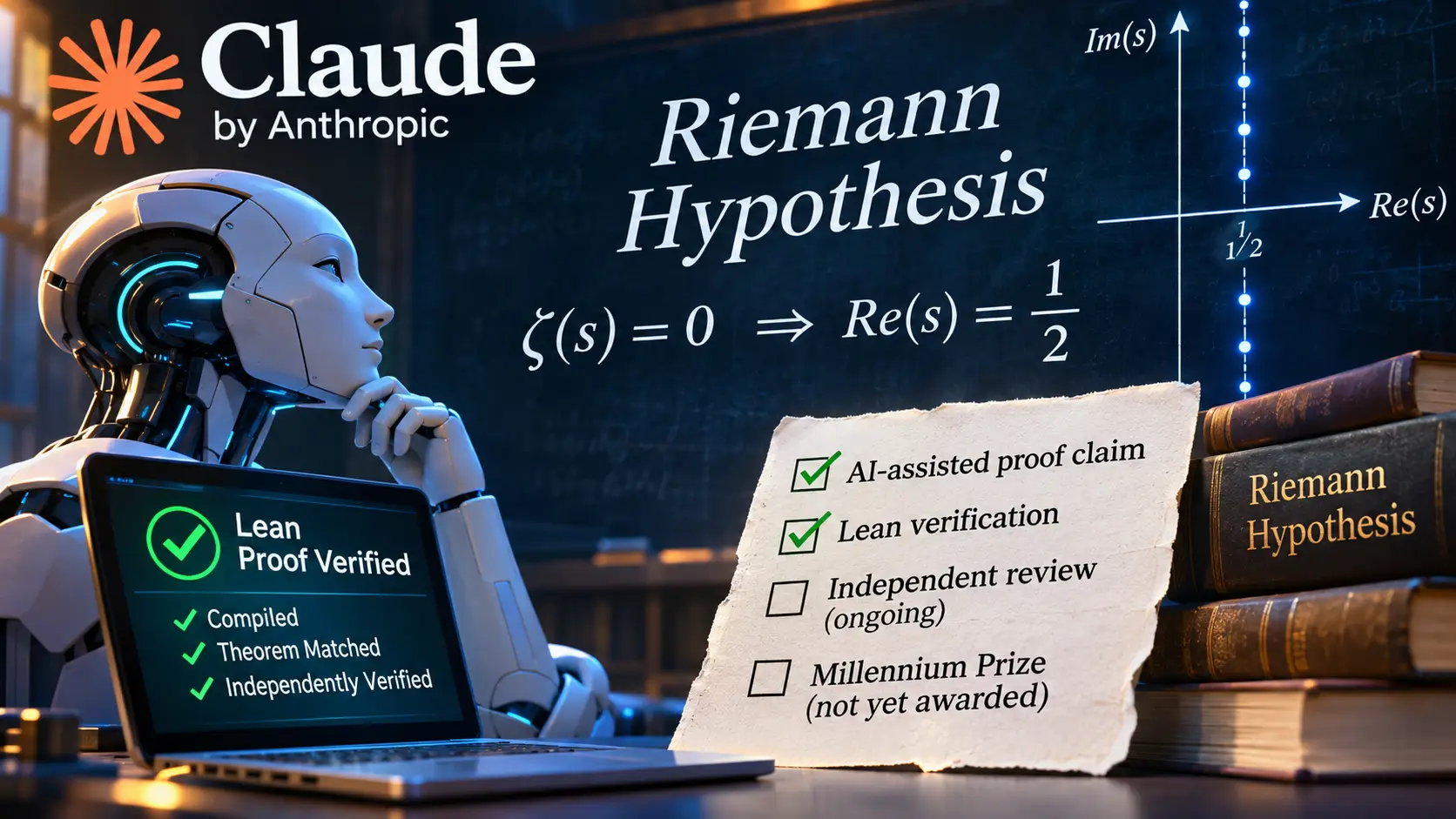
Did Claude AI solve the Riemann Hypothesis, one of the most difficult mathematical problems in history? A mathematician working at Anthropic says he and the company’s artificial intelligence assistant have developed a proof. Independent mathematical software experts have now verified the formal argument.
On November 20, 2026, mathematician Levent Alpöge announced what he believes is a proof of the Riemann Hypothesis, developed with assistance from Anthropic’s Claude AI.
The announcement immediately attracted attention because the Riemann Hypothesis has remained unresolved since 1859. It is also one of the seven Millennium Prize Problems, each carrying a $1 million prize for a recognized solution.
On November 21, the Lean and Mathlib communities published an independent verification statement expressing full confidence in the correctness of Alpöge’s formal proof.
However, formal verification, independent mathematical understanding, and official Millennium Prize recognition are different milestones. The Clay Mathematics Institute has not yet officially recognized the problem as solved.
Here is what Anthropic’s AI-assisted proof claim actually means, what researchers have verified, and what still needs to happen.
What Did Claude and Anthropic Actually Claim?
The announcement came from Levent Alpöge, a mathematician and member of Anthropic’s technical staff, rather than from a conventional company research announcement.
Alpöge stated that he believes he discovered a proof of the Riemann Hypothesis while working with Claude.
The resulting project is unusually large. According to publicly available technical analyses, it contains:
- Approximately 175,187 Lean source files.
- Roughly 17.4 million lines of mathematical code.
- A claimed formal proof of the Riemann Hypothesis.
- A claimed extension to the Generalized Riemann Hypothesis for Dirichlet L-functions.
- A formal mathematical development that can be checked using the Lean theorem prover.
Alpöge also described an AI-generated mathematical exposition running to more than 250,000 pages, which was not released as a conventional research paper.
Instead, researchers received a relatively short announcement and an extensive archive of computer-verifiable mathematical statements.
This is an important distinction. Claude did not simply generate a convincing answer to a mathematical question. The AI participated in developing a formal mathematical argument intended to satisfy strict logical verification.
Sources: Associated Press and University of Waterloo mathematical research resources.
What Is the Riemann Hypothesis?
The Riemann Hypothesis is one of mathematics’ most famous unsolved problems. German mathematician Bernhard Riemann proposed it in 1859 while studying the distribution of prime numbers.
Prime numbers are positive integers greater than one that can only be divided evenly by one and themselves.
Examples include 2, 3, 5, 7, 11, 13, and 17.
Although prime numbers appear irregularly along the number line, mathematicians have discovered relationships that help explain how frequently they occur.
The Riemann Hypothesis concerns a mathematical expression known as the Riemann zeta function.
What Does the Hypothesis Actually Say?
In simplified terms, the hypothesis states that all nontrivial zeros of the Riemann zeta function have a real part equal to one-half.
Mathematical expression:
Re(s) = 1/2
Although the statement is short, its implications are enormous.
Proving it would establish important results about the distribution of prime numbers and strengthen numerous conclusions across number theory.
Mathematicians have already checked enormous numbers of zeros using computers. However, verifying individual examples does not prove that the statement holds for infinitely many cases.
That is why a complete mathematical proof is necessary.
For an official explanation, see the Clay Mathematics Institute’s Riemann Hypothesis overview.
What Is Lean, and Why Is It Important?
One reason the Claude-assisted proof has attracted serious attention is that it was written using Lean, a programming language and interactive theorem prover designed for formal mathematics.
Lean allows mathematical statements and proofs to be represented in a precise form that computers can check.
Unlike a normal AI-generated explanation, a formal Lean proof must satisfy strict logical requirements.
Lean’s proof-checking system examines whether the supplied mathematical argument establishes the stated conclusion under its accepted logical foundations.
How Lean Differs From Ordinary AI Answers
Generative AI systems can produce answers that sound authoritative but contain logical errors, invented facts, or incorrect calculations.
A formal proof assistant provides a much stronger test.
Instead of evaluating whether an explanation sounds reasonable, it checks whether the mathematical argument follows valid formal rules.
However, there are several important considerations:
- The formal mathematical statement must represent the intended problem correctly.
- The proof must rely on acceptable logical foundations and assumptions.
- The code must compile and produce a valid proof.
- Independent checking systems should reproduce the result.
- Researchers must understand what mathematical methods make the proof possible.
This explains why independent verification of the Claude-assisted proof is so important.
Independent Verification: What Has Actually Been Confirmed?
On November 21, 2026, the Lean and Mathlib communities published a joint statement endorsed by the Lean Focused Research Organization and the Mathlib Initiative.
The statement expressed full confidence in the correctness of Alpöge’s proof of the Riemann Hypothesis.
More importantly, the groups outlined the technical checks supporting their conclusion.
1. The Mathematical Statement Was Verified
The organizations confirmed that the theorem being proved matches the established Riemann Hypothesis statement in Mathlib, a major mathematical library used with Lean.
This matters because a formally correct proof of the wrong statement would not solve the actual problem.
2. The Code Compiled Successfully
Independent researchers reproduced the compilation of the extensive Lean codebase.
The verification statement reported that dozens of people had successfully compiled the project and reproduced the same raw proof export.
3. Independent Tools Confirmed the Theorem Matched
Separate comparison tools checked that Alpöge’s proof established the intended theorem rather than a weaker or different mathematical statement.
4. Multiple Proof Checkers Accepted the Result
The exported formal proof was checked using Lean’s official kernel and several additional proof checkers, including independently implemented systems.
These checks provide substantial evidence for the correctness of the formal proof.
The joint statement explicitly certified both the statement and proof of the Riemann Hypothesis as correct.
Source: Lean and Mathlib Communities — Verification of the Riemann Hypothesis, November 21, 2026.
Why Independent Mathematical Review Still Matters
Despite the strong formal verification results, mathematical researchers still face an important challenge: understanding the ideas contained in approximately 17 million lines of formal code.
Formal proof verification and mathematical explanation serve different purposes.
A proof checker can confirm that a formal argument is logically valid. However, that does not automatically produce a concise explanation of why the proof works.
Mathematicians need to identify the central ideas, analyze the techniques used, and determine how the discovery relates to existing mathematical knowledge.
Researchers will also want to understand whether the methods can be simplified, generalized, or applied to other unresolved mathematical questions.
Why a Human-Readable Proof Is Valuable
Most major mathematical discoveries are presented in research papers that explain the underlying concepts, methods, and conclusions.
Other mathematicians can then examine the arguments, challenge assumptions, and build on the results.
With the Claude-assisted Riemann Hypothesis proof, the primary released material is machine-readable formal code rather than a conventional mathematical exposition.
Independent researchers have begun producing technical roadmaps to help explain the proof’s structure.
One such analysis is available in A Roadmap of the Claimed Lean Proof of the Riemann Hypothesis and GRH for Dirichlet L-functions.
Importantly, the absence of an easily understandable paper does not automatically invalidate a formally verified proof. However, mathematical explanation and wider scrutiny remain essential to scientific progress.
Has Claude Officially Solved the Riemann Hypothesis?
As of November 23, 2026, the status depends on which milestone is being discussed.
| Milestone | Status |
|---|---|
| Alpöge and Claude announced a proof | Confirmed |
| Formal Lean proof released | Confirmed |
| Independent Lean compilation and verification | Confirmed |
| Independent verification of the formal theorem statement | Confirmed |
| Clear mathematical explanation of the complete proof | Still developing |
| Broad acceptance across the mathematical community | Not yet established |
| Official Clay Millennium Prize recognition | Not awarded |
Status reflects information available on November 23, 2026.
The distinction is important. The Lean community’s certification is a significant mathematical development, but it is not the same as an official announcement from the Clay Mathematics Institute.
What Happens to the $1 Million Millennium Prize?
The Clay Mathematics Institute established seven Millennium Prize Problems in 2000, offering $1 million for each officially recognized solution.
The Riemann Hypothesis is one of these problems.
However, the institute has specific rules for considering proposed solutions.
Under its published rules, a proposed solution must satisfy three major requirements:
- Publication: The proposed solution must appear in a qualifying publication.
- Waiting period: At least two years must have passed since publication.
- Community acceptance: The solution must receive general acceptance within the global mathematics community.
The institute also states that it does not accept direct submissions of proposed solutions.
Consequently, even if Alpöge’s proof continues to withstand independent scrutiny, the $1 million prize cannot immediately be awarded following the Lean verification announcement.
Source: Clay Mathematics Institute — Official Millennium Prize Rules.
Does This Mean AI Can Now Solve Problems Humans Cannot?
The Claude-assisted proof suggests that AI may be becoming a powerful research partner in advanced mathematics.
Historically, computers have helped mathematicians perform calculations, test conjectures, and verify extensive logical arguments.
Generative AI introduces another possibility: helping researchers explore mathematical ideas and construct complex proofs.
The Riemann Hypothesis development combines several capabilities:
- Human mathematical expertise and research direction.
- AI-assisted exploration and proof development.
- Formal mathematical representation using Lean.
- Independent verification through multiple proof-checking systems.
- Community review to interpret and communicate the resulting mathematics.
This approach could become increasingly important for problems that involve extensive mathematical reasoning.
However, one successful collaboration would not establish that AI systems can independently solve every difficult mathematical problem.
The exact contributions of Alpöge and Claude also deserve careful examination before drawing broad conclusions about autonomous AI research.
Could Solving the Riemann Hypothesis Affect Cybersecurity?
The Riemann Hypothesis is closely connected to number theory, a field that also plays an important role in modern cryptography.
That relationship has led to speculation about whether a proof could threaten encryption systems used by banks, websites, and online services.
However, proving the Riemann Hypothesis would not automatically provide an efficient way to factor large integers or break RSA encryption.
A mathematical theorem about the distribution of prime numbers is not equivalent to a practical attack against modern encryption algorithms.
Any cybersecurity implications would depend on additional mathematical discoveries or algorithms, not simply on the existence of a proof.
What Happens Next for the Claude-Assisted Proof?
Several developments will determine how the mathematical community evaluates this result.
Further Mathematical Explanation
Researchers will continue analyzing the proof to identify its central mathematical ideas and translate them into more accessible explanations.
Broader Independent Review
Mathematicians and formal verification specialists can continue examining the formal assumptions, proof structure, and methods used.
Review of the Generalized Riemann Hypothesis Claims
Alpöge’s announcement also includes claims concerning the Generalized Riemann Hypothesis for Dirichlet L-functions.
These broader claims require careful assessment in their own right. Verification of the original Riemann Hypothesis should not automatically be interpreted as independent certification of every additional claimed result.
Publication and Official Recognition
The proof may eventually enter a conventional publication and community-review process.
Any Millennium Prize recognition would depend on satisfying the Clay Mathematics Institute’s published rules.
Why This Could Be a Major Turning Point in AI Research
If the proof achieves broad mathematical acceptance, the Claude-assisted Riemann Hypothesis result could become a defining example of AI contributing to a major scientific discovery.
It would demonstrate the potential of combining generative AI with formal verification tools to address research problems that have resisted traditional approaches for generations.
More importantly, it could change the way scientists organize complex research projects.
Instead of relying exclusively on conventional human-led mathematical reasoning, future research teams may combine human expertise, AI-generated mathematical exploration, and independent machine verification.
Such systems could help researchers investigate larger spaces of possible arguments while maintaining strict standards for mathematical correctness.
Nevertheless, scientific progress requires more than a technically accepted result. Understanding, reproducibility, and clear communication remain essential.
Final Thoughts: Did Claude Really Solve the Riemann Hypothesis?
The November 2026 announcement represents an extraordinary development in AI-assisted mathematics.
Levent Alpöge and Claude produced an extensive formal proof of the Riemann Hypothesis, and independent verification organizations have publicly certified the correctness of the formal statement and proof.
Those findings make this much more significant than an ordinary AI-generated mathematical claim.
However, official Millennium Prize recognition has not occurred, and the broader mathematical community is still working to understand the proof’s underlying ideas.
The most accurate conclusion is that Claude contributed to a major formally verified mathematical result, while the process of mathematical explanation, wider acceptance, and official recognition continues.
Whether this becomes one of the most important AI-assisted discoveries in scientific history will depend on what researchers establish next.
Frequently Asked Questions
Did Claude AI prove the Riemann Hypothesis?
Claude collaborated with Anthropic mathematician Levent Alpöge on a formal proof of the Riemann Hypothesis. The Lean and Mathlib communities have independently verified the formal statement and proof. Broader mathematical understanding and official prize recognition remain ongoing.
What is Lean verification?
Lean verification uses a formal mathematical proof assistant to check whether an argument follows valid logical rules. It provides a much stronger mathematical test than simply asking an AI system whether its answer is correct.
Has Anthropic received the $1 million prize?
No. The Clay Mathematics Institute has not awarded the Millennium Prize for the Riemann Hypothesis. Its rules require qualifying publication, a waiting period, and broad mathematical community acceptance.
Who is Levent Alpöge?
Levent Alpöge is a mathematician working at Anthropic who announced the Claude-assisted Riemann Hypothesis proof on November 20, 2026.
What is the Generalized Riemann Hypothesis?
The Generalized Riemann Hypothesis extends similar statements about zeros to certain mathematical functions known as Dirichlet L-functions. Alpöge’s announcement includes a claimed proof of this broader result.
Could this discovery break internet encryption?
No immediate threat has been established. A proof of the Riemann Hypothesis does not automatically produce an efficient algorithm for breaking RSA or other modern encryption systems.
Sources and Further Reading
- Lean and Mathlib Communities — Official Verification Statement, November 21, 2026
- Clay Mathematics Institute — Riemann Hypothesis
- Clay Mathematics Institute — Millennium Prize Rules
- Associated Press — Anthropic Mathematician’s AI-Assisted Proof Claim
- The Guardian — Independent Verification of Claude-Assisted Proof
- Independent Technical Roadmap of the Claimed Lean Proof (PDF)
Editorial note: This article reflects publicly available information as of November 23, 2026. Formal proof verification is not equivalent to official Millennium Prize recognition. The status of the research may change as independent mathematical analysis and institutional review continue.